Showing posts with label caddis larva. Show all posts

Monday, February 6, 2012

Chimarra Caddis Larva

Chimarra Caddis Larva 
This bright orange/yellow caddis larva can be an important food source on some waters in my area during the late winter and early spring months.  As far as caddis larva go it is one of the smallest I will bother to imitate.  I tie them on a 3x short hook in sizes 16 & 18, but I know folks tie them smaller (typically 18-20).  The short shank hook allows me to maintain a good hook gap but still keep the body appropriately sized.

I was able to get out this week and enjoy some of the unseasonable warm weather.  This pattern and small patterns with bright orange hot spots produced well, indicating that the fish may be seeing some of these larva already.

Pattern Recipe:
Hook:  3x short larva hook
Thread:  8/0 Hot or Fire Orange for body/Brown for head
Under Body: Orange thread
Markings:  Black marker on thread before wrapping floss
Abdomen: Yellow floss spiraled up hook shank allowing the underbody to show
Thorax: Brown thread
Legs:  Squirrel dubbing

Tying Instructions:

  • Cover the hook shank with orange thread wrapping down the bend of the hook, building up a thicker area over the barb of the hook.  
  • Tie in a piece of yellow floss at the bend of the hook and advance the thread to the eye, whip finish and cut off.
  • Attach brown thread at the hook eye
  • Dot the back of the fly with a black marker a few times
  • Advance the floss towards the eye in open spirals allowing the orange underbody to show through and tie off at the hook eye.
  • Dub a small about of squirrel fur on thread and create the flies legs by making several wraps, pulling the fibers down after each wrap
  • Create a neat thread head, whip finish and cut off thread.
  • Apply a small drop of clear cure goo to the top of the thorax and cure with a UV light to keep the fibers pointing downward
Once this pattern gets wet the colors will change closely resembling that of the natural insect.
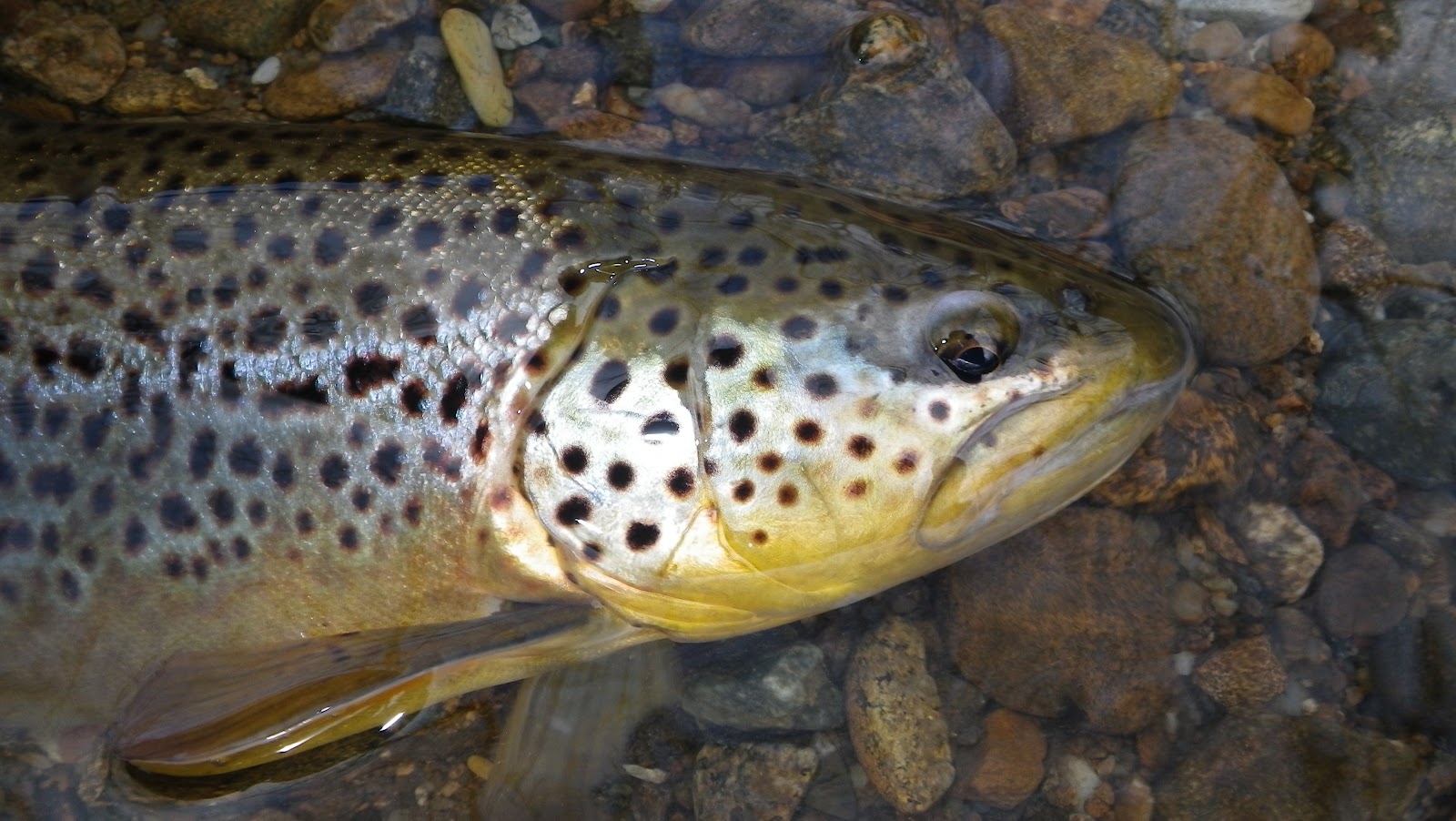
A healthy winter brown trout taken on a Chimarra larva pattern


Tuesday, August 24, 2010

Improvised Cased Caddis


While fishing on Montana's Gallatin River I observed a large number of cased caddis with bright green bodies in this rocky fast flowing river.  Back at the cabin that evening I improvised with the materials we had on hand.  Tungsten beads in two sizes (one just happened to be green), shaggy greenish dubbing, hen feathers and yellow wire.  This was the result.  The double beads sink this one like a stone.  A perfect anchor fly for Czech nymphing.

Did it work?


I'm pretty sure it did...at least on the Madison.

Sunday, February 28, 2010

Polish Woven Nymph

During the Fly Fishing show last month I ran into a friend of mine, Aaron Jasper.  Aaron was tying woven polish nymphs, something I have been doing for years.  I have always liked the appearance of flies with woven bodies but the effort put into tying them always put me off.  Aaron's method of handling the material changed all that.  Using bobbins to weave on the body material really speeds up the process and allows for precise placement of the woven materials.


Some of mine...
This olive over insect green color combination is a great imitation of a caddis larva for the South Branch of the Raritan River.  A stream that I spend a lot of time on every year.  A lead underbody and tungsten bead makes it a good choice for early season high water conditions.

The Mess

This Hare's Ear variant was a real producer for over the last few seasons.  The pattern can not be any simpler to tie!

Recipe:
Hook:  Diachi 1150
Bead: Black glass
Ribbing:  Gold or copper wire
Body: Light brown hare's mask
Abdomen:  Dark brown hares's mask

There is nothing special about this fly in it's appearance, but it is a consistent producer.  It does a good job imitating caddis larva found in most waters.  The fly when dry is quite a mess (hence the name) but it takes on a much different look when wet.  My general nymph box is never without a dozen of these.

Wednesday, February 17, 2010

Magic Dub rock worms


When I cleaned out my old fly tying desk I came across a few packages of EZ Magic Dub.  Magic dub is a fine fuzzy yarn.   I don't remember why I originally purchased this material but it was perfect for creating caddis larva bodies.   A little lead tape for weight, wrap the yarn on for the body, hares ear dubbing for a thorax and a small glass bead for the head.  You can tie one in about a minute and a half.  Here are a few examples.


Sunday, December 13, 2009

Another Killer Czech Nymph


This is another pattern that worked very good for me this last season.  I have modified it slightly with the addition of the deer hair thorax dubbing.  I like this new version even better, hopefully the fish will agree with me.
Recipe:
Hook:Partridge CZ
Inner Ribbing:  Gold wire
Outer Ribbing:  Maxima Mono
Abdomen:  Light olive synthetic dubbing
Hot Spot: Pink ice dub
Thorax:  Simon Thorax dubbing -Brown
Shellback:  Tan magic shrimp foil

Wednesday, December 9, 2009

Another Czech Pattern


This pattern is a heavily weighted nymph with three layers of lead foil tied in at the bend of the hook.  I use it as an anchor fly as it sinks like a rock.

Hook:  Partridge CZ #12
Shell back:  Pink magic foil
Inner Rib:  Oval gold tinsel
Outer Rob:  Gold wire
Abdomen:  Light olive synthetic dubbing
Heart/bright Spot:  Fushia UV dubbing
Thorax:  Tan UV dubbing

Tuesday, December 8, 2009

Czech Nymphs


Here is one of my most effective Czech nymph patterns this last season.  These are quick easy ties, a little sloppy but the fish don't mind.  You can turn out a couple dozen in no time at all.  The key to tying an effective Czech or Polish style nymph is turning out a fly with a good amount of weight and a thin profile.  I will weight these patterns with adhesive backed lead tape or square lead wire.  Both methods will allow you to load a hook with more weight than traditional lead wire.  Some flies have a single layer of lead some a double.  Its pretty easy to figure out which is which by just holding them in your hand.

This pattern is a basic olive Czech Nymph.


Hook:  Partridge CZ #12
Shell back:  Tan Shrimp Foil
Inner Ribbing:  Gold Wire
Outer Ribbing:  Mono
Abdomen:  Synthetic Light Olive Dubbing
Heart/Spot:  Clear UV Dubbing
Thorax:  Brown Hares Mask


Monday, November 23, 2009

Caddis Larva


I picked up this recipe for a caddis larva pattern from Johan Klingberg.  Johan is a fly tier from Sweden who was one of the featured tiers at the Fly Tying Symposium over the weekend.  This a great looking pattern that will sink like a rock.  It will be an excellent pattern to fish with the Polish\Czech nymphing method.  What made this pattern unique was the method in which the dubbing was applied to the hook shank to give that deep segmentation.

Recipe:
Hook:  Partridge CZ hook
Weight: Fine square lead wire wrapped in two layers over bottom third of hook (this is what gives the fly the pronounced lower body)
Rib:  Olive tying thread
Dubbing:  Blue wing olive FlyRite dubbing.  FlyRite is a long fibered synthetic dubbing.  Long fibers are separated from the bunch, then overlapped and tied in by the tips.  Twist the fibers into a rope and wrap on hook.  Wraps should not be touching, leave a little gap and fill in with thread ribbing after tying off dubbing.
Legs:  Hen feather

I dug out some FlyRite dubbing and started playing around with it.  I am going to crank out a couple dozen in different sizes/colors.  This should be a good pattern.