Sunday, April 29, 2012

The Perfect Bass Fly?


Although my writing may not show it, I am an avid warm water fly fisherman. I am forced to be, because the nearest quality trout water is an hour from my house. Fortunately, I am blessed to have a number of warm water venues minutes from my front door. Despite the fact that most of this blog's posts revolve around trout fishing, much of my fishing involves the pursuit of warm water fish.


One of the most effective lures for largemouth bass has to be the plastic worm. For decades, I have been searching for the fly fisherman's equivalent. I believe that search is now over.


At a recent fly tying course offered by Central Jersey Trout Unlimited, I took a break from instructing and sat in on a workshop put on by one of the chapter's most innovative fly tiers, Bill Ninke.  Bill introduced me to materials and techniques to tie very effecting looking worm and tube jig imitations. Bill was quick to point out that these flies were not his original patterns.  He stated he had picked up the patterns and techniques from a source on the internet. The originator of this wrapping technique is Rich McElligott who works hard for the Illinois Smalmouth Alliance.


These flies are quick and easy to tie and they look great in the water.  The pattern's design keeps the long tail from fouling the hook point, an issue I have always had with other worm style flies.  The fly is tied in two stages.  First take a length of yarn equal to whatever you want the overall length of the fly to be and touch the end to an open flame to taper it.  I have been working with a fly that is 5 1/2 inches long. Take the none tapered end and tie it in behind the eye, bead or cone. Take a second piece of yarn three to four times longer than the first and tie it in behind the eye as well. Begin wrapping this longer piece of yarn around the hook shank until you reach the bend. Then continue wrapping the long piece of yarn around the standing portion of the tail. Make seven wraps down the tail then reverse direction and make six wraps back towards the hook.  Now continue wraping on the hook ending back at the eye.  Whip finish, tie off and your done.


I am adopting this technique and material to several new patterns I am developing.  I can't wait to field test them this spring.  I also started tying these flies on wire guard weedless hooks which results in a near weedless version that can be cast into heavy cover without the risk of losing the fly.  It can be weighted by attaching wraps of lead wire to the hook shank before tying on the yarn.

Recipe:
Hook: Mustad 3366 1/0 or substitute a weedless worm hook
Weight: Brass or tungsten cone or wraps on lead wire
Body:  Patons Bohemian Yarn (available at local craft stores)


Thursday, April 19, 2012

Shad Flies


I needed to restock my shad fly box for an upcoming trip this weekend.  Normally I would recruit my 9 year old son to whip up a bunch off shad flies for me, but the lad broke his finger last night so I got stuck behind the vice.  I had only one hour to spend fly tying this evening.  Fortunately, shad flies are quick and easy to tie.  The patterns are only limited by your imagination and fly tying supplies.  For me it is crystal flash, and bright colored standard and crystal chenille, nothing to them.

When tying shad flies your looking for brightness and/or contrast.  These are all tied on an #4 Eagle Claw Nickel Teflon Salmon hook (model NT1197FS).  I carry a assortment of colors and sizes (2-6).  Follow the basic rules - bright flies on bright days, dark flies on cloudy days or low light periods.

Sunday, April 15, 2012

Shad!


Many years ago I chased the Delaware River's shad with spinning tackle.  About fifteen or twenty years ago, I laid the spinning and casting gear down and chased fished exclusively with the fly rod.  Up until this year, I never pursued shad with fly tackle.   One of the main reasons I have never gone after shad with a fly is the timing of the run. It occurs during our primetime for trout.  This year, with so much excellent fishing opportunities this winter, I felt I could take a few days off from trout fishing and finally give shad on the fly a go.  Thanks to some friends who shared their expansive knowledge of fly fishing for shad, I have discovered a new thrill.


These fish are a blast!  Shad eagerly take a fly and on a 6wt fly rod they make a good showing of themselves.  On this tackle you will not land every fish! They will push 6wt gear to its limits and will escape from time to time.  Though they take a fly readily, their bony mouths can offer a bit of resistance to a hook, they are prone to leaping and on occasion a large fish will break a ten pound tippet on the initial strike like it was made of sewing thread!

When the fish are pushing through the action can be hot and heavy.  When they are not, you cast until your arm wants to fall off.  But they can show up at any time, so you cast away.  This time of year it is running lines and fast to moderate sinking shooting heads.  The use of a stripping basket is mandatory.  There is nothing graceful about fly fishing for shad but it can be terribly effective.  Although it is certainly not always the case, on the days I have been out, the fly guys have out produced the spin fisherman.


The flies are ridiculously simple to tie and they are a great patterns for new fly tiers, especially children.  The brighter and gaudier, the better, and the kids love combining colors that would have not have a place on any respectable trout pattern but are perfect for shad flies.  I'll put up a post in the next week or so on the flies used for this species.


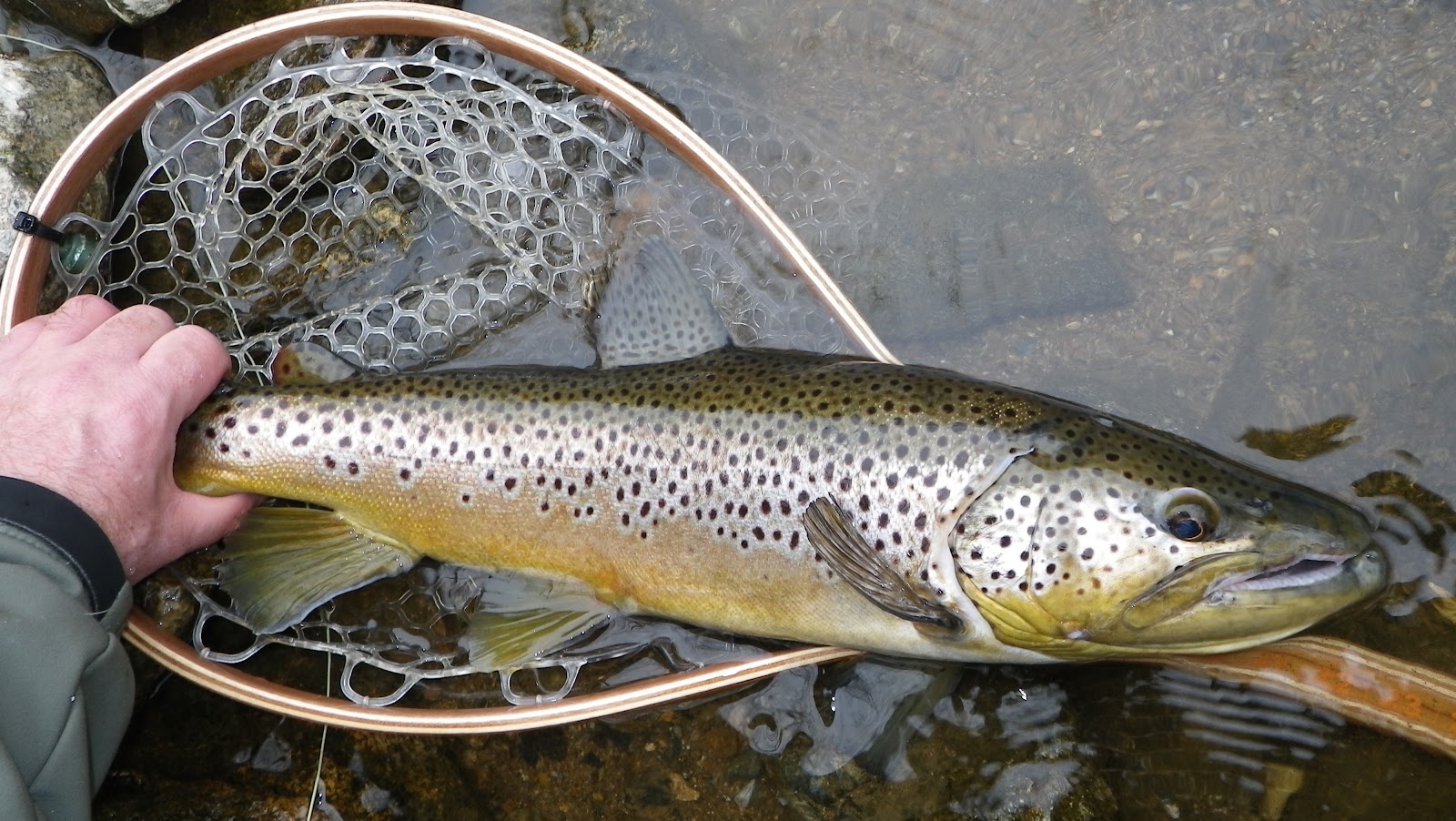
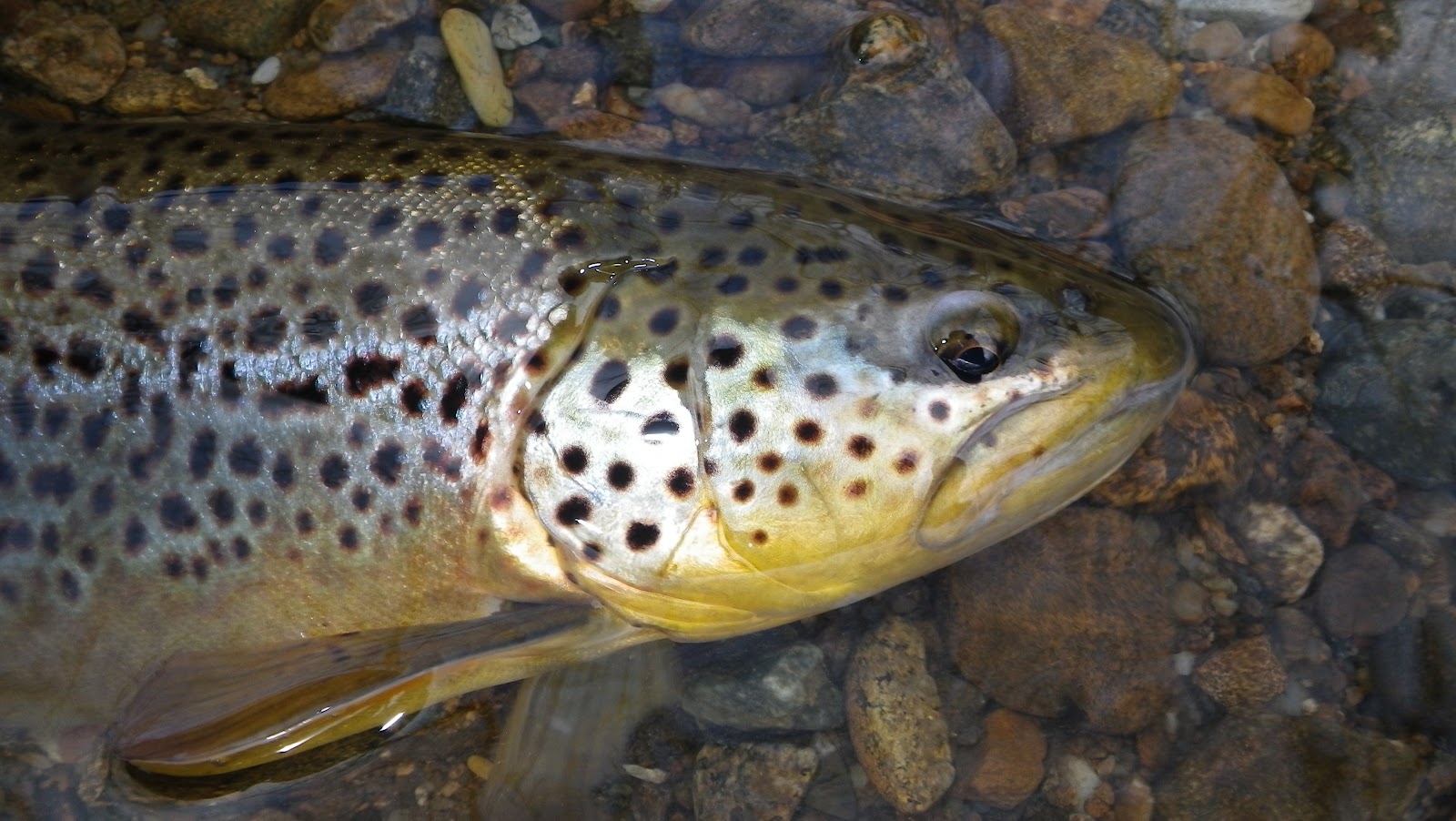
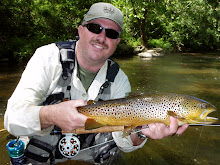
But like most forms of fly fishing, you occasionally connect with a trash fish like this brown trout!  What did I say about colors that don't belong on a respectable trout fly?  I may have to rethink this one!


Wednesday, April 11, 2012

Opening Day 2012

For me, the season opener actually begins the day before on the banks of the very river that will be fished the following day.  A fabulous steak dinner is enjoyed by a fine group of friends and the evening is spent swapping lies around a campfire until one by one we slip off to the warmth of our sleeping bags.  The day starts just before first light with the smell of wood smoke and fresh coffe being brewed by the first man up.  Soon the smells of breakfast being cooked begin to mix with the wood smoke and that is usually enough to wake those that stayed up a little too late the night before.  After breakfast, a few anglers will rush into waders, gather their gear and wait in the frigid water for the eight o'clock bell of the season opener. Most of us continue to linger by the fire until the sun begins to poke over the hills and shares its warmth with us.  Then one by one we'll gear up, find a good looking piece of water and make the first "official" cast of the season. Which, on most years, has been preceded by several thousand casts by those of us who fish all winter long, except for those three long weeks in March and early April when trout season closes on most waters.

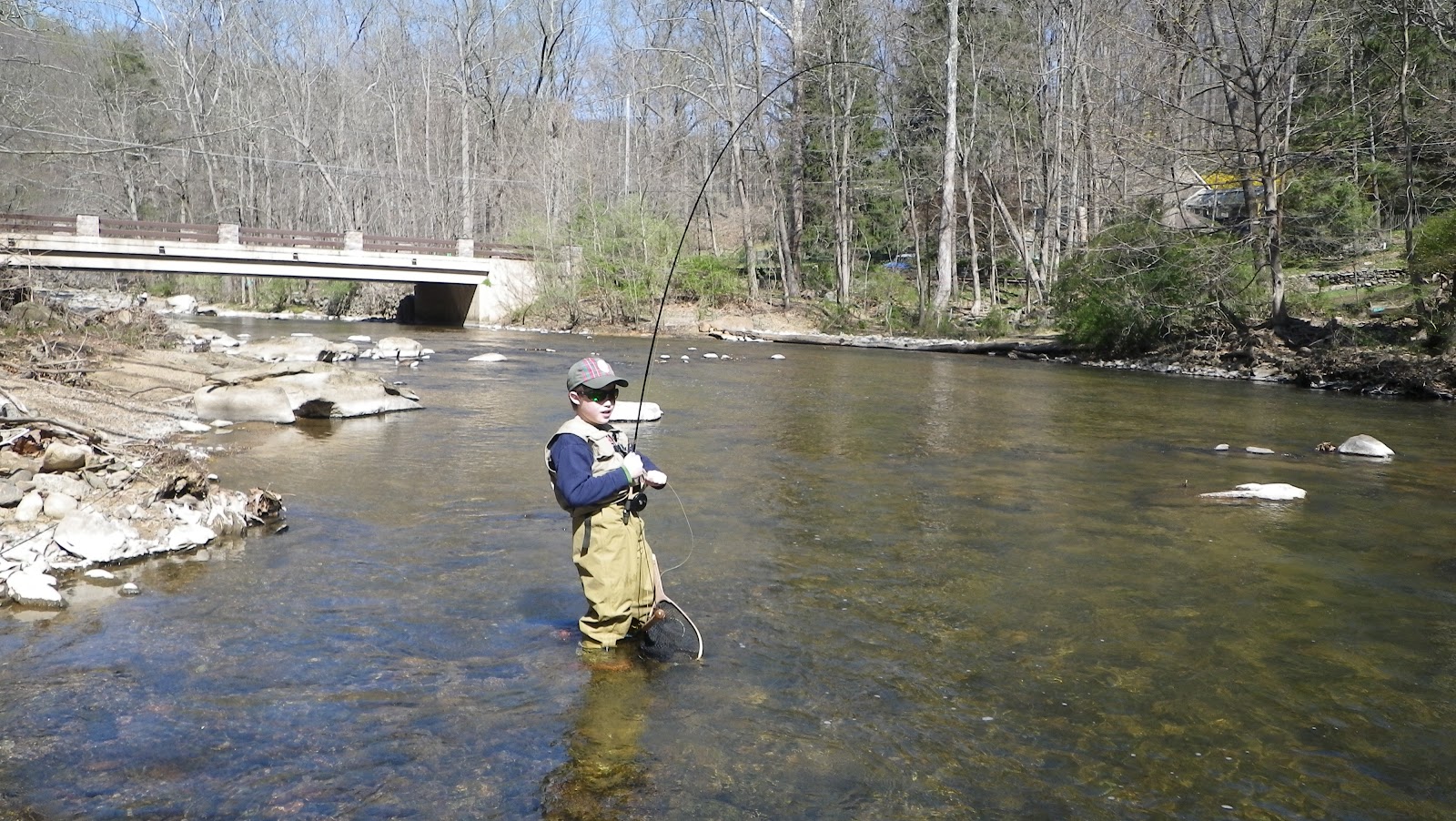
Opening day was a little different for me this year.  This year I had company.  This was the year I introduced my 9 year old son, William, to my opening day traditions.  William has been fishing with a fly rod for a number of years now, but mainly on local lakes and ponds for panfish and the occasional bass.  Last summer I introduced him to wet wading in moving water and once I was confident he understood the basics of safely negotiating rapids and could handle a dunking in moving water, we took a few short trips in preparation for Opening Day.  Armed with a new fly rod and a pair of Dan Bailey waders and Simms wading boots that were given to us by a generous friend whose children had out grown them, he was ready to hit the water


I was thrilled that he was able to make the cast, detect the strike and play his first fish to hand without any assistance from Dad and he did it over and over again.  I stood by his side to coach him, but it became obvious after a while that I was just getting in the way so I sat and watched.


Eventually he asked why I wasn't fishing and then offered to be my gillie if I wanted to fish for a while.  So I did, it was nice to have someone to net my fish for me.


After a few hours he wanted to put down the rod and kick back and relax so I slipped off and managed to tease a few more fish into the net before breaking camp and heading for home.


I'm sure the day created memories that will last a lifetime for the both of us.  Especially that big one that got away!  He'll have stories of his own for next year's campfire!


Friday, March 30, 2012

Hendrickson Nymph


It is Hendrickson time here in New Jersey.  The hatch is a few weeks early due to the mild winter we have experienced here in the north east.  We are all hoping that the bugs stay around long enough for the season opener.  If you want to fish this hatch you can still get out on our trout conservation waters which are open year round, though they are likely to be crowded.  There have been no real prolific hatches report yet but there have been some sightings which mean the bugs are on the move.

Although I fish a number of emerger and dun patterns, I only fish on nymph pattern for this hatch.  I first found this fly in the book Flies for Trout by Dick Stewart and Farrow Allen.  I have been fishing the fly since the early nineties when the book first came out and I have never needed another pattern.  The grey band of dubbing in the center of the fly is essential to the pattern as the naturals often have a lighter coloration mid-abdomen.  I prefer the fly as shown (minus the crazy long guard hard that need to be plucked out!), though you can also add a bead if that's the way you roll.

Recipe:

Hook:  2x long nymph hook size 12 or 14
Thread:  Brown 6/0
Tail:  Well marked wood duck flank barbs
Abdomen: Reddish brown fur with a band of grey fur behind the thorax or in the mid section (look at your local nymphs)
Ribbing:  Copper wire (not in the original pattern)
Thorax: Reddish brown fur
Wing Case: Black section of turkey tail
Legs: Well marked wood duck flank or partridge barbs

These nymphs are active swimmers when emerging so subtle twitches and lift techniques are often productive when fishing this pattern.

Monday, March 26, 2012

"Winter" Fishing Wrap Up


This blog has been far too quiet lately.  My apologies to my regular readers.  Fortunately I have been busy fishing as well as working.  I thought I would share some images from some of my winter trips to the river.  We were blessed with a extremely mild winter this year.  I was able to fish in shirt sleeves or a light jacket for most of the days between December and the present.  Today we have seasonable temperatures in the mid fifties and it feels down right chilly!


The fishing this winter was phenomenal!   Although we experienced extremely high water during the spring, summer and fall, the lack of snow/rain this winter has really brought water levels down,  The low crystal clear water we typical experience in autumn has been with us all winter.  This mild weather has the bugs all confused as well.  Many hatches are several weeks early.  As it looks now we may miss our Hendrickson hatch completely as we suffer through three weeks of closed waters.


I had several months some of the best dry fly fishing I have ever experienced in New Jersey with loads of fish coming to the surface chasing our little black stoneflies.  This hatch has always been hit or miss because of weather and water conditions, but this year we had two solid months of consistent action on stoneflies.


There has been plenty of BIG fish as well.  My best this winter was a twenty six inch brown.  Unfortunately his picture will not be found on this blog because I was without a camera (my friends know that is a regular problem with me), but there are plenty of 22"-24" pictured on this post to make up for it.


Many of these big fish were taken on top but the largest were often taken dredging a nymph on a dark cloudy day.  This spring our rivers were chock full of suckers getting their spawn on.  Unlike some anglers, I have no aversion to matching that particular hatch so I am no stranger to sucker spawn patterns.  If its good enough for a fish to eat, its good enough for me to tie and fish!


When going down low effective patterns were my Yellow Stonefly Nymph, Cased CaddisChimarra Caddis and my trusty Pheasant Tail Anchor.  As far as dry flies went your basic black stone fly imitations produced well, the fish were not too picky.  But the biggest fish always seemed to rise to My buddy Lou's CDC Stone.  Water temps were high enough to get some great action on aggressively stripped streamers as well.


The last few days of the open season were the best.  Daytime temps in the seventies brought the water up into the mid fifties.  With temps like that the caddis and mayflies started popping.  I spent the last day of the open season fishing wet flies to very aggressive fish willing to chase down and absolutely smash the fly.  At the end of the day at dark I was treated to a caddis hatch and took several fish on Iris Caddis fished with movement in the film.


So my apologies again for the lack of posting but a man has to have his priorities.  Fishing will trump writing every time in my book!  I promise things will get back on track and you will hear a lot more from the Jersey Angler in the months to come.

Tight Lines!

Monday, February 6, 2012

Chimarra Caddis Larva

Chimarra Caddis Larva 
This bright orange/yellow caddis larva can be an important food source on some waters in my area during the late winter and early spring months.  As far as caddis larva go it is one of the smallest I will bother to imitate.  I tie them on a 3x short hook in sizes 16 & 18, but I know folks tie them smaller (typically 18-20).  The short shank hook allows me to maintain a good hook gap but still keep the body appropriately sized.

I was able to get out this week and enjoy some of the unseasonable warm weather.  This pattern and small patterns with bright orange hot spots produced well, indicating that the fish may be seeing some of these larva already.

Pattern Recipe:
Hook:  3x short larva hook
Thread:  8/0 Hot or Fire Orange for body/Brown for head
Under Body: Orange thread
Markings:  Black marker on thread before wrapping floss
Abdomen: Yellow floss spiraled up hook shank allowing the underbody to show
Thorax: Brown thread
Legs:  Squirrel dubbing

Tying Instructions:

  • Cover the hook shank with orange thread wrapping down the bend of the hook, building up a thicker area over the barb of the hook.  
  • Tie in a piece of yellow floss at the bend of the hook and advance the thread to the eye, whip finish and cut off.
  • Attach brown thread at the hook eye
  • Dot the back of the fly with a black marker a few times
  • Advance the floss towards the eye in open spirals allowing the orange underbody to show through and tie off at the hook eye.
  • Dub a small about of squirrel fur on thread and create the flies legs by making several wraps, pulling the fibers down after each wrap
  • Create a neat thread head, whip finish and cut off thread.
  • Apply a small drop of clear cure goo to the top of the thorax and cure with a UV light to keep the fibers pointing downward
Once this pattern gets wet the colors will change closely resembling that of the natural insect.

A healthy winter brown trout taken on a Chimarra larva pattern


Thursday, January 26, 2012

The Fly Fishing Show


The Fly Fishing Show opens its doors tomorrow at 10:00am. The show which is being held in Somerset, NJ will run Friday through Sunday. I plan on being there all three days to check out the show and provide free labor, staffing the CJTU booth. I will also be attending the International Fly Fishing Film Festival which takes place immediately following the show on Friday night. If you are in the area and have never attended this event it is well worth it. A lot of folks travel significant distances to attend this show every year. It is one of the largest, if not the largest, fly fishing events held.

If you going to be there drop me a line, send a tweet, whatever... I love to put some faces to the names of the folks I talk with on a regular basis.


- Posted using BlogPress from my iPad

Wednesday, January 4, 2012

An Evenings Work


Over the holiday break I got together with Lou from Fly and Fin, for an evening of fly tying, chili eating and bourbon swilling.  I refilled a couple holes in my nymph box, but it was not the most productive tying session.  I had to keep putting my scissors down to pick up the bourbon glass, which slowed things down, but at least I did not stab myself in the forehead.  That's a story for another time!

Sunday, December 25, 2011