Showing posts with label warm-water. Show all posts

Monday, January 18, 2016

Cold Weather Bluegills

Things can look a little bleak during the winter months.

Cold weather fly fishing for bluegills and other sunfish is often a tough proposition.  Fish leave their shallow water haunts and will typically move to deeper water near structure to find the most comfortable temperature.  As many an ice fisherman will attest to, they do continue to feed throughout the winter months, but not with the same voracity that they do during warmer weather.  Bluegills will move into shallow water on clear warmer days if the sun can warm the water temperature by a few degrees.  Most of the time however it will be a deepwater game.  The good news is if you find one fish you likely to catch others in very close proximity.  In cold water bluegills will gather in dense schools, often with other fish species.  

Presentations need to be slow and takes may be difficult to detect.   I have the best success with small streamers, nymphs, soft hackles and wet flies.  Soft hackles probably account for more fish due to the alluring movement of the feathers during the painfully slow retrieves.

Cover as much water as possible, searching for fish.  Once you detect a strike or catch a fish, thoroughly fish that area.  Once you locate a single fish you are likely to connect with more in the immediate area.  Experiment with the speed and depth of your retrieve until you dial in on an effective presentation.

To be honest,  I much prefer fishing for bluegills during the warm weather of spring and summer (notice the lack of fish pictures in this post).  But when a mild winter day comes along and there is open water to fish,  it beats sitting around the house suffering from cabin fever.   

Sunday, April 29, 2012

The Perfect Bass Fly?


Although my writing may not show it, I am an avid warm water fly fisherman. I am forced to be, because the nearest quality trout water is an hour from my house. Fortunately, I am blessed to have a number of warm water venues minutes from my front door. Despite the fact that most of this blog's posts revolve around trout fishing, much of my fishing involves the pursuit of warm water fish.


One of the most effective lures for largemouth bass has to be the plastic worm. For decades, I have been searching for the fly fisherman's equivalent. I believe that search is now over.


At a recent fly tying course offered by Central Jersey Trout Unlimited, I took a break from instructing and sat in on a workshop put on by one of the chapter's most innovative fly tiers, Bill Ninke.  Bill introduced me to materials and techniques to tie very effecting looking worm and tube jig imitations. Bill was quick to point out that these flies were not his original patterns.  He stated he had picked up the patterns and techniques from a source on the internet. The originator of this wrapping technique is Rich McElligott who works hard for the Illinois Smalmouth Alliance.


These flies are quick and easy to tie and they look great in the water.  The pattern's design keeps the long tail from fouling the hook point, an issue I have always had with other worm style flies.  The fly is tied in two stages.  First take a length of yarn equal to whatever you want the overall length of the fly to be and touch the end to an open flame to taper it.  I have been working with a fly that is 5 1/2 inches long. Take the none tapered end and tie it in behind the eye, bead or cone. Take a second piece of yarn three to four times longer than the first and tie it in behind the eye as well. Begin wrapping this longer piece of yarn around the hook shank until you reach the bend. Then continue wrapping the long piece of yarn around the standing portion of the tail. Make seven wraps down the tail then reverse direction and make six wraps back towards the hook.  Now continue wraping on the hook ending back at the eye.  Whip finish, tie off and your done.


I am adopting this technique and material to several new patterns I am developing.  I can't wait to field test them this spring.  I also started tying these flies on wire guard weedless hooks which results in a near weedless version that can be cast into heavy cover without the risk of losing the fly.  It can be weighted by attaching wraps of lead wire to the hook shank before tying on the yarn.

Recipe:
Hook: Mustad 3366 1/0 or substitute a weedless worm hook
Weight: Brass or tungsten cone or wraps on lead wire
Body:  Patons Bohemian Yarn (available at local craft stores)


Friday, September 23, 2011

All may not be lost...

Photo from NJ Fish and Wildlife website

New Jersey Fish and Wildlife have been working hard to salvage the fish from the draining lake in my previous post.  Still no word on what the eventual outcome for the lake will be but the division is working hard to save as many fish as possible.  

Here is a report on the situation from their webpage:

September 21 Update:
An additional 1200 fish were removed from Prospertown Lake on Tuesday, September 20. The fish were relocated to Pemberton Lake WMA. The lake will be monitored over the next two weeks to evaluate if any additional removal/relocation is required.
September 16 Update:
An additional 2000 fish were collected from Prospertown Lake and relocated to Turnmill Pond on Thursday September 15. A total of approximately 3000 fish have been relocated thus far. The lake water level will be monitored over the weekend. Another day of electrofishing is planned for early next week.

September 15, 2011

The NJDEP Division of Fish and Wildlife has been performing a fish salvage operation at Prospertown Lake (Ocean County) since the outlet structure failed earlier this week resulting in the lake's water level dropping substantially. The lake, a popular fishing destination, is located within the Prospertown Lake Wildlife Management Area.
As of Tuesday, September 13, 2011, approximately 1,000 black crappies, bluegills, yellow perch, brown bullheads and largemouth bass have been collected by Division Bureau of Freshwater Fisheries biologists and Bureau of Land Management personnel. The fish have been have been relocated to Turnmill Pond located on the nearby Colliers Mills WMA. Two electrofishing boats are being used to stun the fish, allowing staff to net and transfer them into a nearby hatchery truck.
The failure at the 80-acre lake in Hornerstown is believed to have been caused by the deterioration of the lake's outlet valve coupled with the additional flows from recent storm events. The exact cause of the failure will be determined once the lake drains and a thorough inspection of the outlet can be made. The lake is managed by the division.

Wednesday, September 21, 2011

Death of a fishery...


Hurricane Irene hit the northeast pretty hard.  Two of my local warm water haunts were destroyed by the storm. Both impoundments suffered a catastrophic dam failure and subsequently bled out.  What happened to the pictured lake left is a bit of a mystery.  The dam looks intact, but it appears that the floodgates may have ruptured.  Water is still rushing out at an alarming rate from the base of the dam but the waterline is no where near the dam at the current time, so I have no idea where the water is coming from.  The coves and shorelines are littered with the remains of fish.


On the back side of this high and dry island (to the right of the egret) Icaught my largest NJ bass of 2011, a spawned out female that pushed the scales to the seven pound mark. This was a favorite place to fish. I could be on the water in minutes from leaving my driveway. It was a convenient place to drown some flies after work and still be home in time to put kids to bed.


I saw NJ Fish & Wildlife in there during the week trying to rescue fish from the receding waters. I have no idea what the future holds for this lake. Will the dam be repaired, the lake restocked and restored to it's former self? Or, will it slowly dry out and return to a meandering stream.  Only time will tell...

Thursday, July 7, 2011

Toothy Critters

I have been encountering quite a few of these fellows during my last few warmwater outings.  The larger specimans usually make short work of the 1x or 2x leaders I typically fish for bass.  They are causing me to spend a lot of hours, at the tying bench, replacing lost bass bugs.  Some of these pickeral have been real brutes getting close to typical northern pike size, but these smaller guys can usually brought to hand without the risk of a bite through. Even these little ones can make short work of 1x tippet if they get the chance. 

 I think the next time I visit this particular lake I am going to tie on a short flexible wire tippet and target some these  larger pickeral.  I am also experimenting with some  braided lines as tippet material.  So far they are holding up well but I have not hooked any big fish with this set up to really put it to the test.  On light tackle they are great sport, they often spend as much time out of the water as in.  

Rising Lippa 4 Life Special Blend with Leash
The Rising Lippa4Life tool  makes handling these fish a breeze.  Especially when fishing from a kayak.  In addition to being toothy there a bit on the slippery side and a writhing, snapping pike or pickeral thrashing around between your legs on the bottom of the kayak is an adrenaline filled experience to say the least.

Mono or flourocarbon tippets don't stand a chance!

Tuesday, July 5, 2011

Summertime Fly Fishing


I enjoy warmwater flyfishing as much if not more than trout and saltwater fishing.  Though I have to travel about an hour from my front door to find a decent trout stream, I can walk out my front door and be casting over water in about 5 minutes.  The area I live in is peppered with lakes and ponds of all sizes.  Since New Jersey's trout fishing is a 3 season affair for me, I need something else to occupy my time during the summer months.  That means bass, panfish, carp, and the occasional trip to the beach for some salty action.


Panfish are probably my favorite.  Abundunt, scrappy and great fun on a three weight.  Early mornings and late evenings can often produce some great topwater action.  Probing the depths during the day will produce some of the biggest fish of the day.  They tend to school up by size class, so if you locate a good sized fish you bound to find some more in the same area.


You will find these little fish in all colors of the rainbow from drab to brilliant.  Not to mention that they are some of the finest eating on the planet.  No need to feel guilty about taken the occasional stringer of fish home either.  In most waters around here they are ignored and thereby abundant, sometimes too abundant and the population can certainly sustain a few meals a year.

Sunday, May 22, 2011

'Gill Time...


nuff said...

Tuesday, February 1, 2011

Variation on a Theme...The Warmwater Chub

Bob Jacklin's South Branch Chub
One of my favorite streamers for my local waters is Bob Jacklin's South Branch Chub.  Bob Jacklin resides in West Yellowstone, Montana and owns and operates Jacklin's Fly Shop.  Bob grew up in New Jersey and spent a lot of time fishing my home river the South Branch of the Raritan.  He developed a trim little streamer pattern called the South Branch Chub which proved deadly on this and other local rivers.  When he moved out west he took his patterns with him and they worked well in the Yellowstone region as well.

When I first tied this pattern it introduced me to a new fly tying material, Monga Ringtail.  Monga Ringtail is a wide striped (bared black & white) tail with average hair length of about 2".  It makes for outstanding streamer hair wing flies.  The fur is fine, easy to work with and has great action in the water.  The length of the hair it limits its usage to smaller streamers, which is possibly the reason it is not more popular as a fly tying material.

One of my most effective streamers last year for crappies and large mouth bass was a small streamer loosely based on this pattern. The fly retains the teal feather and black & white monga ringtail wing, but it is tied fuller and lacks the dubbing wax coating. The South Branch Chub is tied very sparse and the fibers are slicked back with a light coating of wax.  Changes were made to the body material, a red throat was added and doll eyes and an epoxy head replaced the fragile and expensive jungle cock.

The Warmwater Chub
I have never fished it as a trout fly but as a warmwater pattern it excels.  Pickerel, Bass and Crappie jump all over this streamer.

Recipe:

Hook: #8 TMC 777SP
Thread: Black UTC 140 denier
Body:  Pale Olive Bug Yarn
Throat:  Red hackle fibers
Wing:  Black over White Monga Ringtail
Over Wing:  Teal feather fibers
Eyes:  Small doll eyes coated with epoxy

This year I have been tying this pattern substituting Clear Cure Goo for the epoxy and have found it to be a great substitute.  I like to give it a finishing coat of clear nail polish to avoid stickiness you sometimes get with UV cured products.

Wednesday, September 1, 2010

A Perfect Evening

I was able to sneak away for a few hours yesterday evening.  A two minute drive put me on the water.  No camera, I just fished...bluegills, crappie, and a few smallish bass.  A handfull of flies, a spool of tippet, nippers and hemostats, simple fishing.  A perfect way to enjoy the last few hours of the day.

Friday, August 27, 2010

Bass Fishing at Walt Disney World


I just returned from a vacation with the family.  We visited Florida's Walt Disney World and I was able to sneak away for a few hours for some early morning fishing.  I caught a bunch a fish (probably 15 or more in a 2 hour period).  All the fish were in the 3-5lb range with few bruisers thrown in for good measure.  I lost one really good fish that threw the fly at the side of the boat.  The guides are very accommodating, they are willing put you on fish using any method you prefer be it bait, artificial or flies.  If you plan on fly fishing you will need to bring your own equipment.

Saturday, August 14, 2010

Fat Albert


I came across this fly for the first time on my trip to Montana last month.  I picked up a few to bring home as tying samples thinking they would tear up the warm-water scene around here.  On a whim I ended up tying one on the end of my tippet while fishing the Gardiner River instead of the hoppers everyone was using.  The trout were all over it.  I fished it a bunch of times during the rest of my trip and it always produced.  This fly is PHAT!

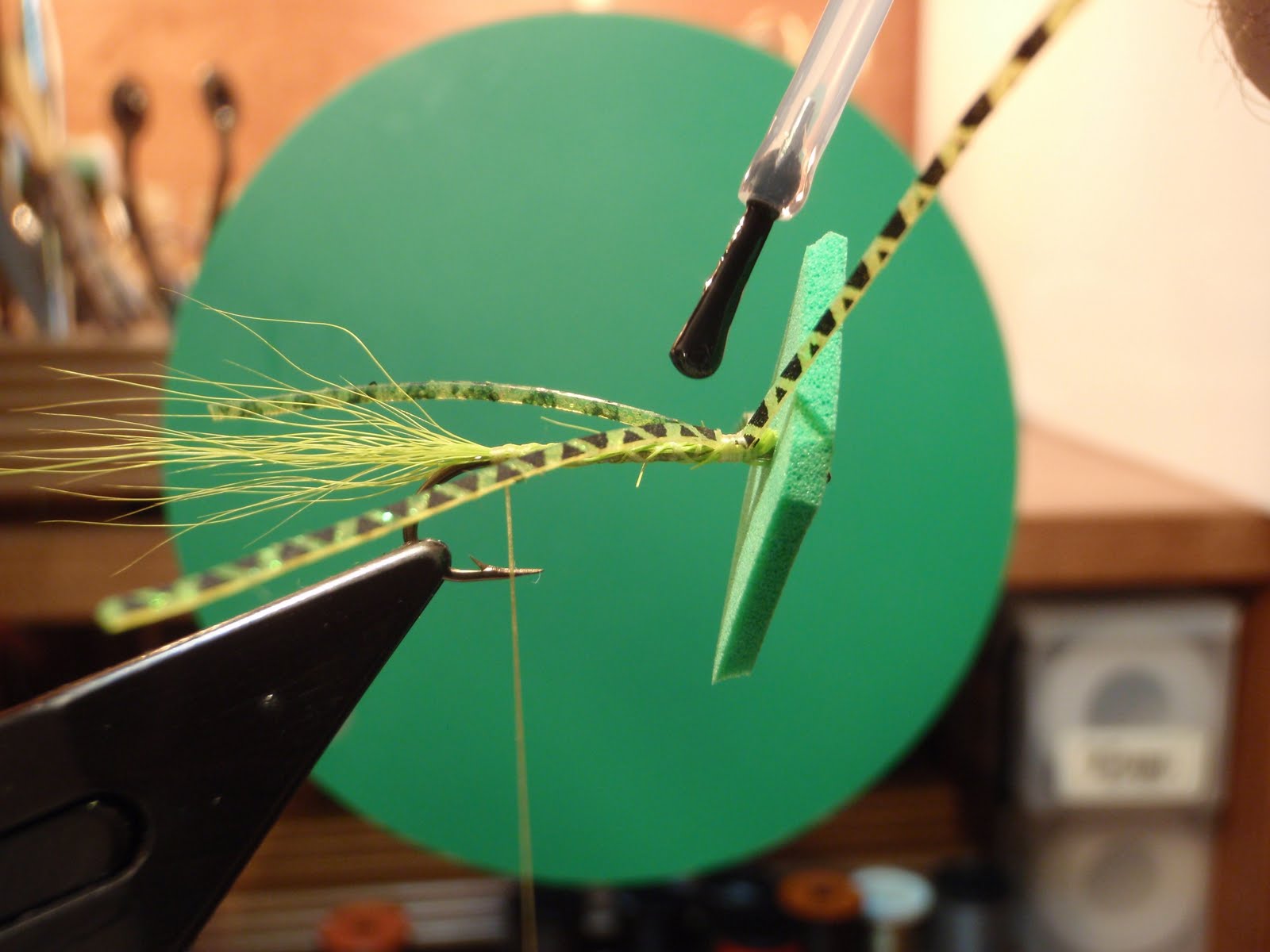
It's relatively easy to tie.  Thread body, contrasting colors of foam, centipede legs, and antron for the wing.  I have a cutter that made perfect bodies without a lot of trimming so I am able to crank them out pretty quick.   

Here's a few shots to explain the construction.  I think its pretty self explanatory. 


Sunday, May 30, 2010

The Bluegill Bug


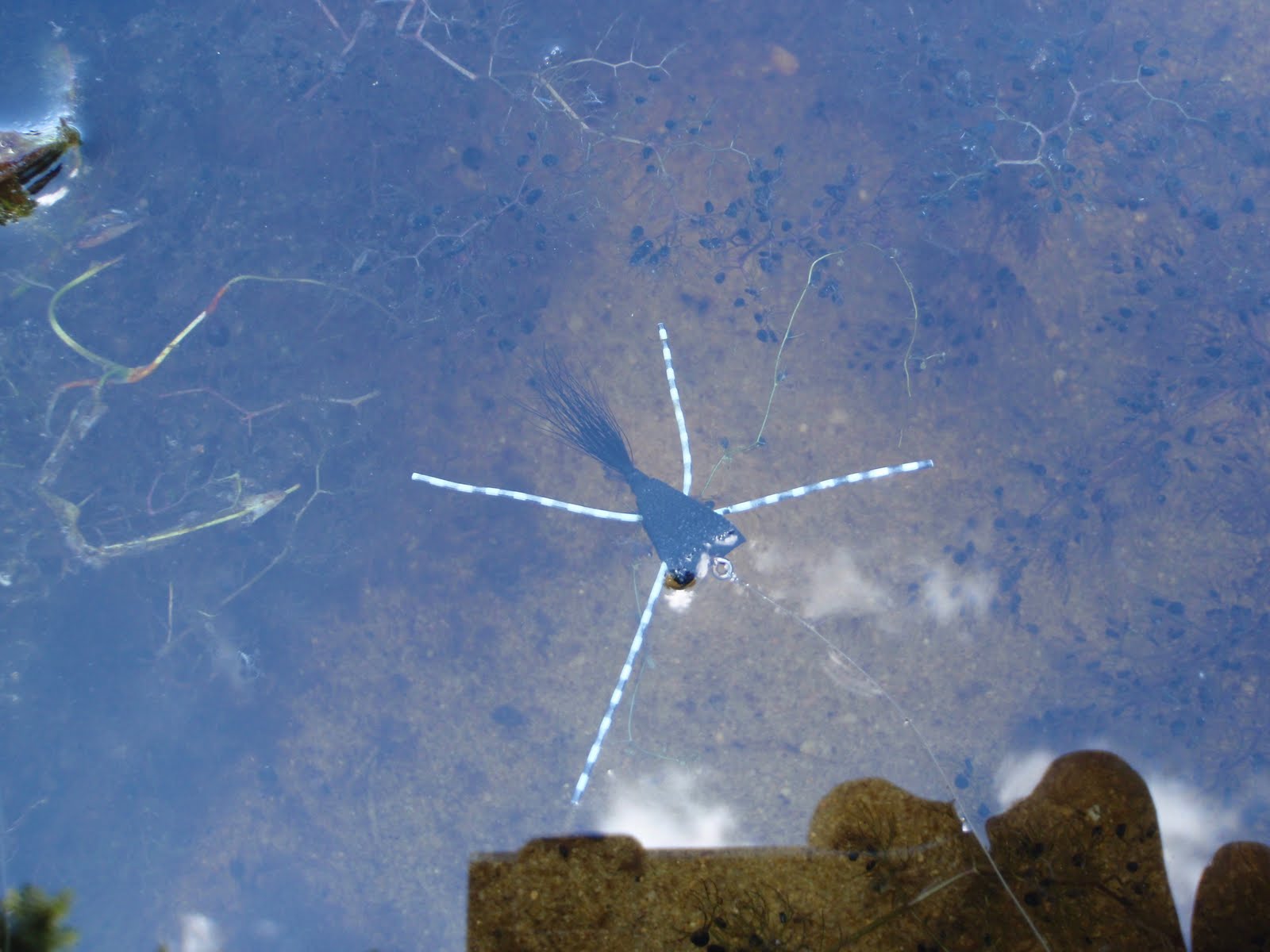
This is one of my favorite bluegill flies.  This little floating triangle with legs has been doing a number on panfish and bass for over a decade.  The unique shape is perfect small mouthed panfish like bluegills.  The thin profile at the business end of the hook allows even the smallest fish to take it with ease but the broad head prevents the little buggers from taking it to deeply.  If you have ever tried to remove a deeply set hook from the mouth of a bluegill with out harming it you can appreciate this.

I tie this fly in small sizes (10) for panfish and larger sizes (6-2) for bass in a variety of colors.  My favorite colors are black, green and chartreuse, yellow and black,  and frog (white bottom green top).


Pattern Recipe:
Hook:  4x long streamer hook
Thread: 6/0 or 3/0 Uni color to match body
Body: 2mm foam trimmed to the shape of a diamond (for the bluegill fly pictured here I start with a rectangle of foam 1" long and 3/8" wide before trimming)
Tail: Bucktail
Legs: Round rubber color of choice


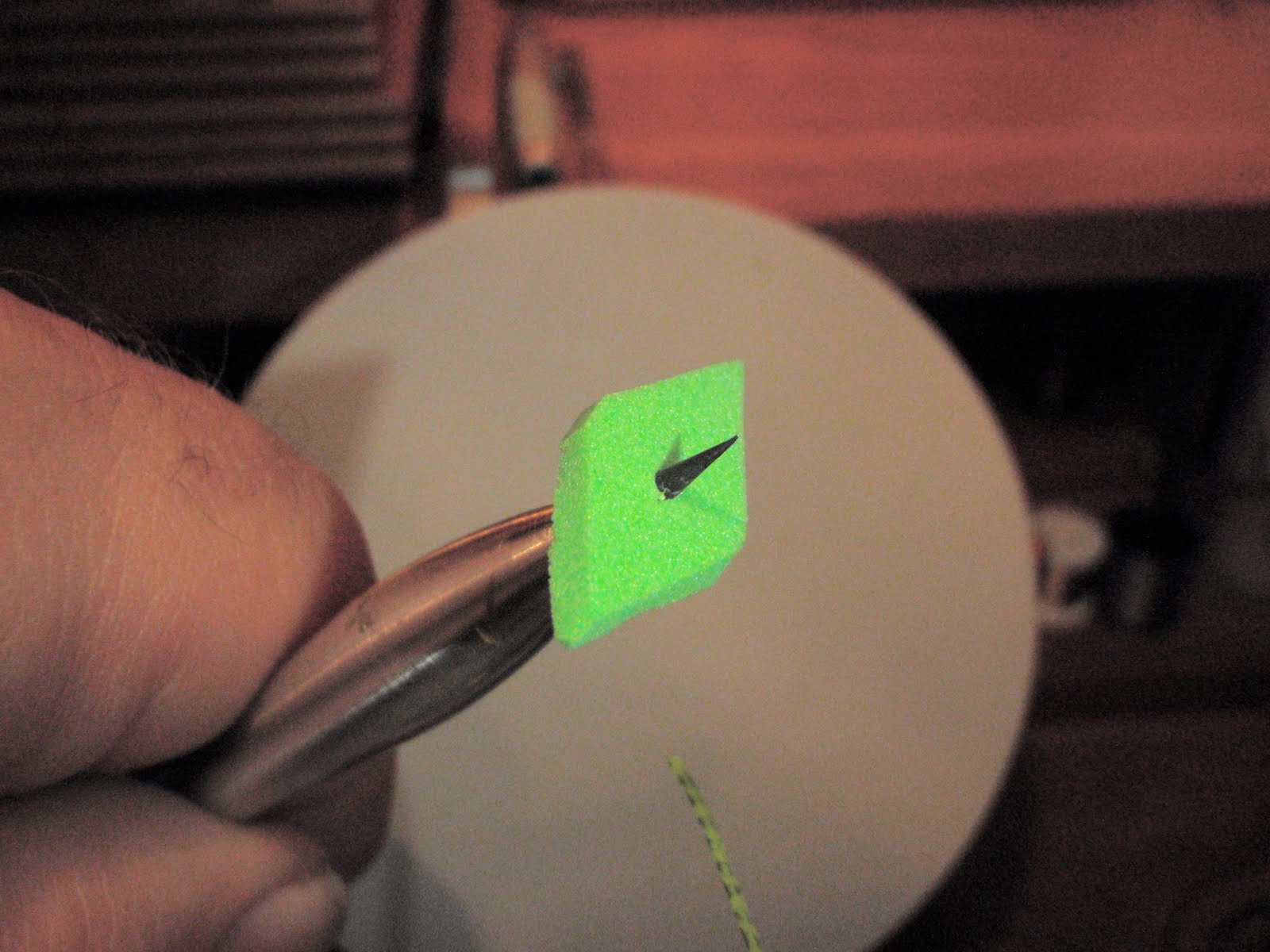
Tying up these flies could not be any easier.  Start by cutting a piece of foam into a diamond shape.   I use 2mm foam for the smaller flies and thicker stuff for the bass flies.


Tie in your buck tail and lash down the butts along the hook shank.


Tie in your rubber legs.


Take your bodkin and poke a hole in the center of the diamond shaped foam.


Slide this hole over the eye of the hook and coat the hook shank with super glue.


Squeeze the top and bottom together to form the triangle and lash down the back with your tying thread, tie off and your done


Bugs

Thursday, May 27, 2010

Got one before all hell broke loose...

I managed one fish this evening before the skies opened up and the mother of all thunder storms sent me scurrying for my car!

Monday, May 24, 2010

Tenkara USA Ayu

I fished the Tenkara USA Ayu this week.  I took this 13' rod down to a local pond and had a blast tearing up the local panfish and bass population.
Since fish in small ponds are oriented to shoreline structure there was not too many areas I would normally fish that were out of reach.  Playing bluegills and crappie on this rod was a lot of fun. Even a 4" bluegill put a serious bend in the rod.  That same rod had no problem landing largemouth bass up to about 16", which is pretty amazing.  I did lose one bass about 3-4lbs but I think I would have lost that fish even if I was using traditional fly tackle.  I was not looking to target bass on this particular trip but they showed a fondness for a black foam spider that was meant for panfish.
These 12"-14" bass were a blast to catch.  I was surprised that I was able to leverage them away from cover with this rod, but it worked just fine.  As I said earlier,  I had a bass between 3 and 4 pounds blow up on one of those foam spiders and he parted that 4x tippet like it was sewing thread.
One disadvantage to fishing such a long rod from shore is the overhanging cover.  You definitely have to pick your spots if you are fishing a shoreline with a lot of trees.  I can't wait to try this rod from the kayak.  With the 13' of rod and 18' of line and leader, there is no place I can't reach.  I find on average I probably don't cast more than 15 to 20 feet in these situations anyway.  In addition, I may have found the perfect set up for crappie.  I did not lose a single fish today.  The ultra flexible rod keeps the flies from tearing out of those paper thin mouths. More on that later...


Saturday, May 8, 2010

Afternoon was a bust...

This afternoon's fishing was called off due to 40 mph winds that blew up as a cold front blew in.  I was planning to fish from my kayak but was blown off the lake. Sight fishing was out of the question because of the wind's effect on the surface.  So rather than walk the shore fishing blindly, I put the boat back on the roof and went for a hike.  It looks like the bluegill feast will have to wait a day or two.  Maybe tomorrow...
Warm Water Tenkara

The gills are on their beds, I'm on my way out the door to see if I can muster up some dinner.  Tenkara should be the perfect solution for these fish in the shallows.

Friday, April 16, 2010

Field Testing

My seven year old son has been very anxious to test out a new wet fly pattern he developed a some weeks ago.  We had a few hours to spare after dinner yesterday so we loaded up a box with his flies and headed out to a local pond.
The fly...

A bright, buggy wet fly that the bluegills and crappie got stupid over.  I even connected with a largemouth about 3-4 lbs that threw the hook on the first jump.  It is gonna be a new addition to my panfish box.  I have to put him to work to tie me some more!