18 hours ago
Showing posts with label tenkara. Show all posts
Tuesday, March 1, 2016
Crappie Kebari
Tenkara has become my favorite way to fish for Crappie and other panfish. I have converted one of my favorite, brightly colored soft hackles into a reversed hackle, kebari style fly. I have had quite a bit of success with this pattern over the last few seasons. Sometimes it performs a little better, other times the fish prefer the pattern tied as a traditional soft hackle. On a tenkara rod this one feels right.
Pattern Recipe:
Hook: Standard wet fly ( the one pictured is an old, no longer made Mustad with a wicked barb)
Thread: 6/0 Uni your choice of color
Body: Chartreuse Ice Dub
Thorax: Pink Ice Dub
Hackle: Hen pheasant tied reversed
Wednesday, February 3, 2016
Tenkara Angler Winter 2016
The 2016 winter issue of Tenkara Magazine has hit the digital news stands. It is a great read with over 100 pages of tenkara goodness. Covering everything from techniques, fly tying, and everything in between it is a great read if you have any interest in tenkara. 
You can check out the winter edition for yourself here.

You can check out the winter edition for yourself here.
Sunday, September 11, 2011
Grayling In the lower 48
Grayling are a species of fish that have always intrigued me. Usually associated with the far north and Europe, they are an exotic fish for a fellow that hails from New Jersey. On our recent trip to Yellowstone Country we had an opportunity to fish for grayling in the park.
Grebe Lake has a healthy population of both grayling and rainbow trout. The lake is an easy 3 mile walk from the road, the trail is as about as flat as they come for that part of the world. Roughly three quarters of the shoreline is fishable, the rest of it is a tangle of deadfall from the big fire. The lake once served as a hatchery for the park in the early days but any traces of that operation are long gone. If you make the trek you will be rewarded with fine fishing in a wilderness setting. There are a couple of primitive campsites on the lake as well, if a overnight stay interests you, The walk is easy enough to consider packing in a float tube. Just be sure to check with the park on regulations concerning camping and watercraft.
My trips to this water usually occur in mid July and on every trip I have been blessed with blizzard like damsel fly hatches. This year was no exception. As a bonus, the fish showed no preference between the nymph or the adult fly. Top water or down low, it was all up to the fisherman to decide! Last trip out the adult damsels were a subtle olive color and this year they were a brilliant blue.
For nymphs a basic olive damsel pattern would work as good as anything else.
The highlight of the day however, is when we switched over to tenkara gear to take these fish. Fishing with a tenkara rod proved much more effective and a hell of a lot more fun on these chunky, little fish.
Even a ten inch grayling would give you a run for your money, as the bend in my buddy Rick's rod clearly demonstrates. Grebe Lake is a place I find myself coming back to year after year. Its not a place your going to catch a wall hanger, but you will certainly experience quality fishing!
Friday, August 12, 2011
Brookies and Bears
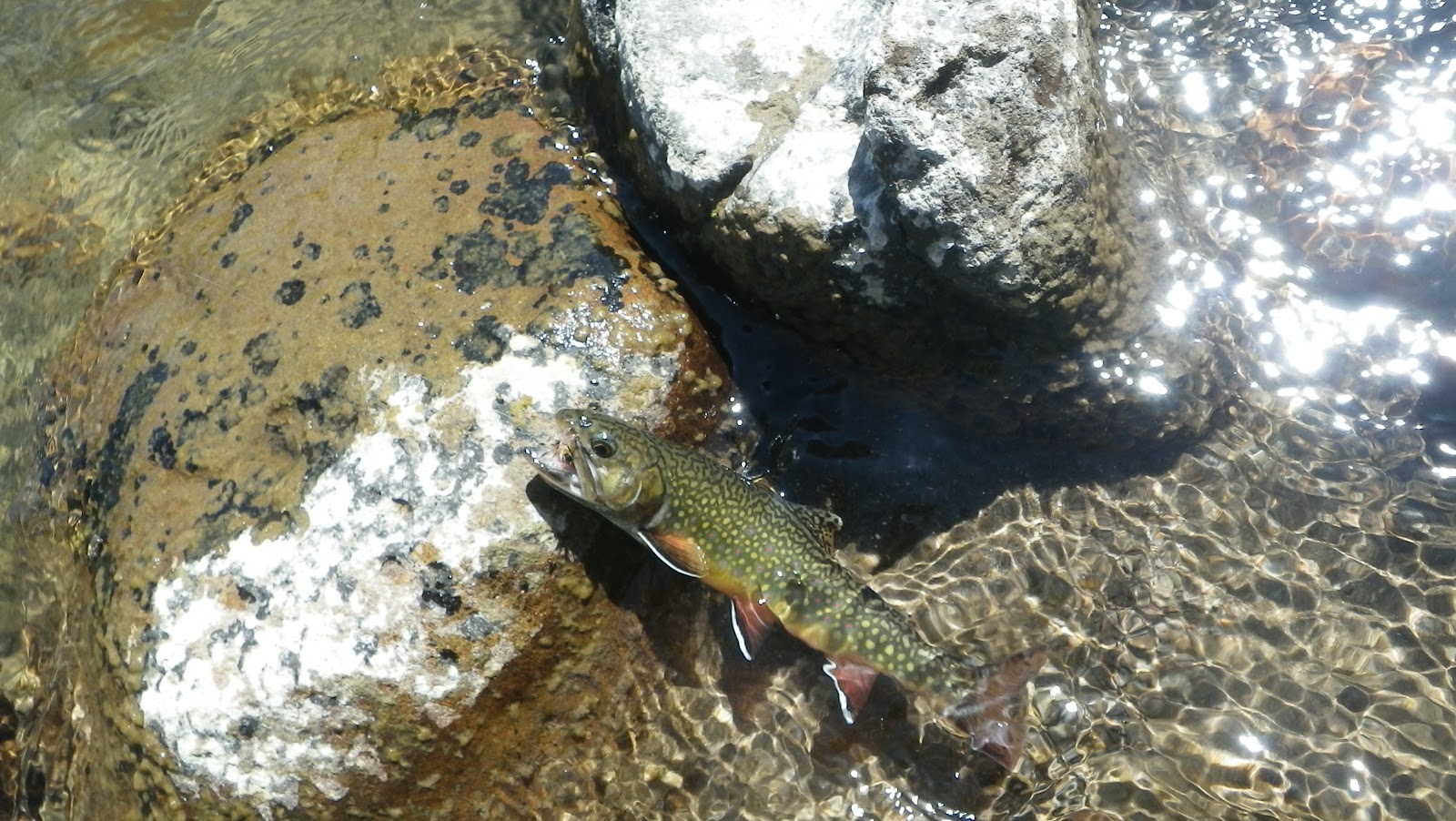
During my recent trip to the Yellowstone area we spent an afternoon on a small, off the beaten track, piece of water. A short hike, of a few miles, rewarded us with a day of great dry fly fishing. This particular stream was loaded with brook trout. Every piece of holding water held one or more fish. In reality, it did matter where you cast as the fish seemed to be everywhere! The numbers added up quickly, as we worked our way up stream casting flies to fishy looking water.
I started fished with conventional fly gear but quickly switched over to Tenkara as the water was perfectly suited for it. Once I changed over to Tenkara the fish came even quicker. Tenkara is THE PERFECT technique for fishing dry flies on small waters.
Fly selection was simple, a deer hair bee pattern was the only fly needed on that day. These little brook trout were not selective, which was a nice change of pace from the maddening, match the hatch scenario on the Henry's Fork the night before.
The fish were small but they were numerous. Most were little hand sized brook trout with a few 11 or 12 inch fish in the better water. I had a refusal from a 14" fish late in the day. That fish would have been a trophy for this water.
As we were packing up for the hike out we encountered a young grizzly. Things became tense for a few moments when instead of fleeing he rapidly closed the distance between us to about 25-30 yards. He then paced back an forth a few times before finally circling off to our right and slipping out of sight over a hill. I managed to get a few crappy photos. Manipulating a small point and shoot camera and bear spray simultaneously with two shaking hands is no easy task!
Unfortunately, when the bear finally left us, he left in the direction of the trail home. When I zoomed in to take this last picture of the bear disappearing over the hill, I hoped it would be the last we saw if him...it wasn't. We crossed paths with him two more times on the way home, luckily he had no interest in us during those encounters.
Brookies and bears in the backcountry! A wild experience in the place these magnificent creatures, both large and small, call home!
- Posted using BlogPress from my iPad
Location:Yellowstone National Park
Monday, October 18, 2010
Tenkara Net
(Photo from Tenkara USA)
I recently acquired a traditional Tenkara net from Tenkara U.S.A. Actually I received the net from my buddy Rick who shares my passion for all things Tenkara. Tenkara U.S.A.'s net appears to be well constructed. The fit and finish of this product is far above the $67.95 price point. It is a beautiful looking piece of equipment.
(Photo from Tenkara USA)
Two things intrigue me about this design. First is the overall shape of the net. The circular hoop and the bent handle are different from it's western counterparts. The circular hoop stems from the fact that traditionally these nets are constructed from a single tree branch with a pair of perpendicular branches (Tenkara U.S.A.'s net appears to be made from two pieces of wood). These branches are brought together and fused to form the circular hoop for the netting. From what I have learned the bent handle allows the net to be carried on a belt by simply inserting the handle behind the belt. This design keeps the net at the ready and keeps the actual net away from the body allowing the fisherman to move about freely. Another benefit allows you to quickly tuck the net into your belt or under your knee when kneeling to go hands free which would come in handy for photographing your catch, reaching for your forceps, etc.
The net is a fine almost monofilament type material with an ultra fine 2mm mesh. It's claim to fame is that hooks will not snag in it and the fine mesh is gentle on fish. Since the net is still unused I cannot attest to either claim yet. The fine mesh looks like it would be destroyed if a hook did catch in it and the coarseness of the net material has me wondering about the "gentle on fish" issue. By all accounts this is a net designed for smaller fish. It would feel right at home on some of the smaller wild trout waters in my state. I think if I attempted to use it on my home river I would be staring at a jagged hole in the bottom of the net after my first attempt to land a larger fish.
The blog at Tenkara U.S.A. has some interesting posts on how these nets are made. As well as more details on the design behind these interesting pieces of angling equipment.
- Posted using BlogPress from my iPad
Tuesday, August 10, 2010
Tenkara USA - Great Customer Service
While I was out in Montana I experienced the misfortune of breaking the tip on one of my tenkara rods.
No fault of the rod, just a bone head move on my part.
When I returned home, I placed an order for a new tip section. Two days later I was holding the new tip section in my hands. Repairing one of these rods could not be easier. Simply unscrew the cap on the base of the butt and remove the damaged sections then insert the new replacement section.
No fault of the rod, just a bone head move on my part.
When I returned home, I placed an order for a new tip section. Two days later I was holding the new tip section in my hands. Repairing one of these rods could not be easier. Simply unscrew the cap on the base of the butt and remove the damaged sections then insert the new replacement section.
Everything is back together and the rod is good as new. Note to self...no more attempts to drag 20+" brown trout out of log jams.
Keep up the good work guys!
Tuesday, August 3, 2010
Tenkara Line Holder
Jason Klass from Backpack Flyfishing has posted a neat line holder for tenkara lines.
Photo from backpackflyfishing.com
I love the simplicity of this set-up. I have been been using tenkara rods quite a bit this season. I've learned that you definitely need a method for managing your line when breaking down the rod. I will break down the rod every time I change locations because walking around with a 13' rod fully extended is flirting with disaster. A way to quickly store your line and leader is an essential part of the system. Nice job on this one!
Wednesday, May 26, 2010
Old Split Tail on Tenkara
A good fish on Tenkara...
We picked up a bunch of fish today plying the waters with tenkara rods and flies. Landing fish in the 20" class with these rods is still the glass ceiling. I fished the 13' Ayu today, the added length allowed me to cover even more water but really did not assist much with the big boys. Rick does a good job playing this fish. The key to landing larger fish is to keep them close once they run out on you and force you to lower the rod tip your done...
My friend Rick with a good fish on Tenkara.
Monday, May 24, 2010
Tenkara USA Ayu
I fished the Tenkara USA Ayu this week. I took this 13' rod down to a local pond and had a blast tearing up the local panfish and bass population.
Since fish in small ponds are oriented to shoreline structure there was not too many areas I would normally fish that were out of reach. Playing bluegills and crappie on this rod was a lot of fun. Even a 4" bluegill put a serious bend in the rod. That same rod had no problem landing largemouth bass up to about 16", which is pretty amazing. I did lose one bass about 3-4lbs but I think I would have lost that fish even if I was using traditional fly tackle. I was not looking to target bass on this particular trip but they showed a fondness for a black foam spider that was meant for panfish.
These 12"-14" bass were a blast to catch. I was surprised that I was able to leverage them away from cover with this rod, but it worked just fine. As I said earlier, I had a bass between 3 and 4 pounds blow up on one of those foam spiders and he parted that 4x tippet like it was sewing thread.
One disadvantage to fishing such a long rod from shore is the overhanging cover. You definitely have to pick your spots if you are fishing a shoreline with a lot of trees. I can't wait to try this rod from the kayak. With the 13' of rod and 18' of line and leader, there is no place I can't reach. I find on average I probably don't cast more than 15 to 20 feet in these situations anyway. In addition, I may have found the perfect set up for crappie. I did not lose a single fish today. The ultra flexible rod keeps the flies from tearing out of those paper thin mouths. More on that later...
Since fish in small ponds are oriented to shoreline structure there was not too many areas I would normally fish that were out of reach. Playing bluegills and crappie on this rod was a lot of fun. Even a 4" bluegill put a serious bend in the rod. That same rod had no problem landing largemouth bass up to about 16", which is pretty amazing. I did lose one bass about 3-4lbs but I think I would have lost that fish even if I was using traditional fly tackle. I was not looking to target bass on this particular trip but they showed a fondness for a black foam spider that was meant for panfish.
These 12"-14" bass were a blast to catch. I was surprised that I was able to leverage them away from cover with this rod, but it worked just fine. As I said earlier, I had a bass between 3 and 4 pounds blow up on one of those foam spiders and he parted that 4x tippet like it was sewing thread.
One disadvantage to fishing such a long rod from shore is the overhanging cover. You definitely have to pick your spots if you are fishing a shoreline with a lot of trees. I can't wait to try this rod from the kayak. With the 13' of rod and 18' of line and leader, there is no place I can't reach. I find on average I probably don't cast more than 15 to 20 feet in these situations anyway. In addition, I may have found the perfect set up for crappie. I did not lose a single fish today. The ultra flexible rod keeps the flies from tearing out of those paper thin mouths. More on that later...
Saturday, May 22, 2010
The minimalist approach of Tenkara
One of the things I like the most about Tenkara is the simplicity. Rod, line and a handful of flies is all you need.
Over the winter I picked up this simple set up with Tenkara in mind. This handmade lanyard/fly holder is made by Goertzen Adventure Equipment. They make two types; one with a fold out fly patch and one that will hold a standard Wheatley fly box (or similar sized box). This simple accessory holds all the flies you need for a day on the water, extra tippet, tools, and what ever else you feel the need to attach to it. I have two of these set ups. The one pictured above is set up for pursuing bluegills, the second one holds my traditional Tenkara flies.
Open up the fly patch and grab what you need. The design holds wet and dry flies without crushing hackles. If you lined them up nice a pretty you could carry several dozen flies no problem.
Over the winter I picked up this simple set up with Tenkara in mind. This handmade lanyard/fly holder is made by Goertzen Adventure Equipment. They make two types; one with a fold out fly patch and one that will hold a standard Wheatley fly box (or similar sized box). This simple accessory holds all the flies you need for a day on the water, extra tippet, tools, and what ever else you feel the need to attach to it. I have two of these set ups. The one pictured above is set up for pursuing bluegills, the second one holds my traditional Tenkara flies.
Open up the fly patch and grab what you need. The design holds wet and dry flies without crushing hackles. If you lined them up nice a pretty you could carry several dozen flies no problem.
Wednesday, May 12, 2010
Backpack Fly Fishing's Tenkara Leader Management System
I saw this today and I have to share it. Backpack Fly Fishing's tenkara leader management system is the best idea I have seen in a long time. Simply brilliant, get the details on his blog.
Saturday, May 8, 2010
Warm Water Tenkara
The gills are on their beds, I'm on my way out the door to see if I can muster up some dinner. Tenkara should be the perfect solution for these fish in the shallows.
Landing large fish on Tenkara...HOW???
I'm at a loss on this one. I know it can be done but I am having a hard time doing it. Yesterday's fishing was stellar, lots of fish, lots of BIG fish. The problem was I could not hold the larger fish with the Tenkara rod. I was told that I should not fish with a tippet heavier than 5x with the Yamame rod. With 5x tippet it has been impossible for me to land fish over 18"
Today I hooked more fish over twenty inches than I have in a long time. I could not land a single one. I came close twice but in the end the fish won. The rest of the fish either broke me off on the their first run or took off for parts unknown at some stage of the fight. This style of fishing really puts you on even terms with the fish. Average stream trout 10-14" are more fun then they should be on this type of rod. You feel every head shake and throb. Getting them to hand is enough of a challenge to keep it interesting.
Even smaller specimens will put a good bend in this rod. Fish seem more acrobatic as well, maybe it has something to do with the angle of the line and the pressure that is exerted on them but they seem to spend a lot of time in the air.
I did manage to land a few good fish in the 18" range. The last fish of the day was a nice brown. This guy was one of the larger fish I was actually able to bring to hand.
I hooked some real bruisers yesterday but simply could not control them! As the day wore on I started picking up on mistakes I made that caused me to lose larger fish. One big one seems to be lowering the rod tip on strong runs. By lowering the rod tip you lose some of that spring effect and it often results in a broken tippet. Keeping the rod tip high allows the flex of the rod to offer some protection against the line parting but a 20+" fish just puts too much pressure on the system and lines break or hooks pull free.
I have a request. I know a lot of people are interested in Tenkara by the traffic these posts are generating. Does anyone have suggestions for fighting large fish on Tenkara rods? I would love to hear from you. Post a comment or email me at jerseyangler@me.com
Thursday, May 6, 2010
Tenkara Yamame
I thought I would talk a little about the Tenkara rod I have been using for nymphing. The rod is called the Yamame. This rod is has the most backbone out of all of the rods offered by Tenkara USA. This rod can easily handle a team of two to three nymphs and is also your best choice for fish over 16" in length, which is a common occurrence on my home river. Like all Tenkara rods this rod has an ultra soft tip section but it has a substantial amount of power in its mid and butt sections. It feels considerably different from my second Tenkara rod, the Ayu, which is a foot longer but feels much lighter. To date the largest fish I have landed on the rod this year was a 18" rainbow taken out of very fast water. I lost a fish in the 22"-24" range on my last outing but I really can't blame that debacle on the rod. The Yamame is 12' long which gives it excellent reach for my preferred method of nymphing.
Tenkara rods are described with ratios, the Yamame is given a ration of 7:3. As I understand it it means the top 30% of the rod is soft and the bottom 70% of the rod is much stiffer. By comparison the Ayu has a ratio of 5:5. I need to experiment with some of the other rods, but the Yamame is doing everything I ask of it when it comes to nymphing. I can highly recommend it.
Tuesday, May 4, 2010
Tenkara Nymph Leader
I would like to describe the leader setup I am presently using for my Tenkara nymphing. As I previously stated I first became interested in Tenkara because the equipment seemed like it would work out well for Czech nymphing. This method of fishing uses little to no fly line and employs longer than normal fly rods. As I found it very difficult to find a fly rod longer than 10' long in this country, I thought the 11'-13' Tenkara rods may be a viable solution. As it turns out they are...
The Leader Material
Though I don't feel it is necessary I decided to try the authentic level line used with these rods. The level line comes in a bright pink color which works out quite well as a sighter. It is available in two strengths 10lb and 15lb test. What I do like about this line is its stiffness which I feel helps in delivering a team of flies. I thought I may have a hinging problem because I use soft supple tippet material but the "casting" method used for Czech nymphing with Tenkara rods poses no such problem.
You will need to add a few new knots to your repertoire if you have never used this type of material or fished Tenkara before. The knot illustrated on the right is used to attach you leader to the braided section of line attached to the rod tip. This knot is extremely simple to tie. The first time you tie it you think "this will never work", but it works like a charm and you can remove it from your rod by simply pulling on the 1/2 tag end that you leave.
You will also need a new knot for attaching your tippet to the level line, though you can probably get by with out it. This tippet knot is also very easy to tie. The illustration does not show it very well but you are only leaving a 1/2 inch of tag at the base of that figure 8 knot. I played around with running droppers off the main line in this fashion but the line is too heavy/stiff for Czech nymphing (not to mention the bright pink color)
The Leader Material
Though I don't feel it is necessary I decided to try the authentic level line used with these rods. The level line comes in a bright pink color which works out quite well as a sighter. It is available in two strengths 10lb and 15lb test. What I do like about this line is its stiffness which I feel helps in delivering a team of flies. I thought I may have a hinging problem because I use soft supple tippet material but the "casting" method used for Czech nymphing with Tenkara rods poses no such problem.
You will need to add a few new knots to your repertoire if you have never used this type of material or fished Tenkara before. The knot illustrated on the right is used to attach you leader to the braided section of line attached to the rod tip. This knot is extremely simple to tie. The first time you tie it you think "this will never work", but it works like a charm and you can remove it from your rod by simply pulling on the 1/2 tag end that you leave.
You will also need a new knot for attaching your tippet to the level line, though you can probably get by with out it. This tippet knot is also very easy to tie. The illustration does not show it very well but you are only leaving a 1/2 inch of tag at the base of that figure 8 knot. I played around with running droppers off the main line in this fashion but the line is too heavy/stiff for Czech nymphing (not to mention the bright pink color)
Detail of Tenkara rod tip
Leader Design
Tenkara techniques call for a leader up to a rod and a half in length. So for the 12' Yamame rod I am using, that would mean a 18' leader. That worked out to be too long for Czech nymphing. It forced you to hold the rod tip too high, effectively becoming a high sticking technique. If you high stick, then you may want to consider the longer leader. What I ended up with, was an overall leader length of 13 or 14 feet. This allowed me to fish close in and at full reach but still get my flies down. You may have to experiment with the length of level line used but basically I am running a couple feet 5x tippet to my first dropper then positioning my flies 18"-20" apart.
Looking at the illustration above your level line will end at the surface of the water or slightly below. This means you will have to play around with the length of level line and tippet based on the depth of the water. The water I fish with this method is fairly consistent in depth so I have not had to do a lot of fooling around with leaders. I have not actually measured my level line section but I believe it is no more that 6'-8' long (I'll check this and post a correction if needed). Once I worked out the details I have not had to change my leader much other than adding or subtracting tippet. Your results may vary...
Sunday, May 2, 2010
More on Tenkara Nymphing
I have been playing around with several Tenkara rods for the last few weeks. Since there has not been much dry fly activity going on (at least not for me), my experiences with fishing Tenkara has mostly been a subsurface one. I'd like to share a few early observations:
Tenkara rods work well for several styles of nymphing. All of the nymphing I have done have been tight line methods meaning fishing without an indicator. Being an avid follower of European techniques over the last few years, the Czech or Polish style of nymphing was the first method I tried. This method works very well with Tenkara since you have little to no fly line past the rod tip wen fishing in this manner. My first concern was being able to handle two or three heavy flies on a rod with such a light tip. As it turns out, this poses no problem at all. In fact I think that ulta soft tip may actually help more than hurt by giving you that extra split second to react before the fish ejects the fly. The extra length that these rods provide is definitely a benefit. With a 11'-13' rod you can cover a lot of water. My experiences to date have shown this is a very effective method of nymph fishing with this type of set up.
One issue that you have to take into consideration is how to handle retrieving flies that become snagged on the bottom. I don't think you want to apply too much pressure or violent jerking with these rods, nor do you want to pull straight back on them. As long as you can grab your leader you can just break them off. But even 5X tippet resisted my efforts to break off by applying tension solely with the rod. Often you can collapse the rod to get a hand hold on you leader. A snag on a drift when the flies are on the bottom 13 feet away with deep angry water in between you and your leader is an interesting dilema.
I'll post more on this subject in the days to come. Next I'll talk about a typical leader set up for this style of fishing.
Tenkara rods work well for several styles of nymphing. All of the nymphing I have done have been tight line methods meaning fishing without an indicator. Being an avid follower of European techniques over the last few years, the Czech or Polish style of nymphing was the first method I tried. This method works very well with Tenkara since you have little to no fly line past the rod tip wen fishing in this manner. My first concern was being able to handle two or three heavy flies on a rod with such a light tip. As it turns out, this poses no problem at all. In fact I think that ulta soft tip may actually help more than hurt by giving you that extra split second to react before the fish ejects the fly. The extra length that these rods provide is definitely a benefit. With a 11'-13' rod you can cover a lot of water. My experiences to date have shown this is a very effective method of nymph fishing with this type of set up.
One issue that you have to take into consideration is how to handle retrieving flies that become snagged on the bottom. I don't think you want to apply too much pressure or violent jerking with these rods, nor do you want to pull straight back on them. As long as you can grab your leader you can just break them off. But even 5X tippet resisted my efforts to break off by applying tension solely with the rod. Often you can collapse the rod to get a hand hold on you leader. A snag on a drift when the flies are on the bottom 13 feet away with deep angry water in between you and your leader is an interesting dilema.
I'll post more on this subject in the days to come. Next I'll talk about a typical leader set up for this style of fishing.
Monday, April 26, 2010
Fly and Fin: Jersey Angler and Tenkara
A friend of put up some video of nymphing with a Tenkara rod from a few weeks back. I like how he gets me on film almost falling on my ass but doesn't show me landing the fish. Thanks buddy! Fly and Fin: Jersey Angler and Tenkara. You may want to go directly to the u-tube links below, for some reason the whole video is not showing up on his blog.
Video 1
Video 2
Video 1
Video 2
Tuesday, March 30, 2010
Tenkara Nymphing
Ok so we could get the flies to the fish but what would happen if we connected with a good sized fish. Moments after the above video was shot my buddy Rick hooks up with that big brown. The fish ran about the tail of the pool as I tried to find my camera. It promptly ran out of the pool into the fast water below. Rick manages to hold on to him and get out onto some of the boulders to continue follow the fish. In the end it is fish one tenkara zero.
Finally we are able to get a fish to hand. Not a big fish but a strong one in fairly fast water.
Tenkara techniques definately hold promise, I look forward to some more experimentation.
Thursday, January 14, 2010
More Tenkara Flies...
A good friend sent me this picture of some traditional Tenkara dry flies he tied. Boy, they don't get any simpler than this. Two materials, thread and hackle. I find the forward slanted hackle very interesting too. As soon as the new desk gets squared away I'm going to tie up a bunch.
Wednesday, January 6, 2010
Tenkara Debate
Last night at a board meeting for Central Jersey Trout Unlimited a friend and I were explaining the Tenkara method of fly fishing and showing off the equipment (rods, lines, flies, etc) to our fellow board members. A debate quickly surfaced... is Tenkara considered fly fishing. Obviously my friend and I were on the yes side of the debate but there were a surprising number of people who did not consider it fly fishing. Was it the lack of a reel, the method of presentation, the unorthodox (to them) equipment? Many arguments were made both for and against but in the end no one changed their opinion. Some of us considered it fly fishing at its roots, fly fishing simplified...just rod line and flies. The others did not know what to call it, but they would not call it fly fishing.
Subscribe to:
Posts (Atom)