Wednesday, April 13, 2011

Trifecta Plus One....

Although it's not a rare occurance, pulling off a trifecta on my local river doesn't happen too often.  It is predominantly a brown trout fishery with a healthy number of rainbows sprinkled in for good measure.  Brook trout are not as common and what is even less common, at least in the area of river I fish, are smallmouth bass.  Over the weekend I pulled off the quadfecta...brown trout, rainbow trout, brook trout and the elusive smallmmouth bass.

First at the gate was this fellow.  As I said previously we don't see many catchable size smallies on this section of stream.
The Elusive Smallmouth Bass

Second up is the rainbow trout, fairly common in faster sections of the stream and they do quite well in this river.


Next up is my favorite, the brown trout.  My best fish from this stream was a brown that stretched the tape past the 28" mark.  In the early season, once the chill comes off the day the browns start to feed pretty regularly but they definately show a preference for overcast days.

Some big...
Some not so big...

Finally the brook trout...most of what you catch will look like this.

Typical brook trout

But once in a blue moon you'll be lucky enough to find one that looks like this...

Not so typical brook trout

I don't know where this fella came from but he was in prime shape.  Perfect fins and a lean muscular body that has spent a season or two in the river.  My personal best for this stream.  All and all it was a great season opener!


One final note...
As I was gearing up for the day someone made the comment that I would not be sneaking up on any fish that day wearing my new yellow Fiberglass Manifesto t-shirt.  I guess the fish were color blind that day or they loved the new design!  Thanks Cameron!

Wednesday, April 6, 2011

Getting Down Deep - The Cased Caddis Anchor

Cased Caddis Anchor
Faced with the prospect of high water flows on the season opener this weekend, I spent a few hours working on a few anchor fly patterns.  I was inspired to tie this particular pattern by my three year old son.  He was walking around the house with a piece of chartruese colored nylon twine around his neck.  Not wanting him to string himself up I took it away from him.  As I was getting ready to throw it away, I realized it would make a perfect larva head for a peeking caddis pattern.  A jig hook, large facetted/slotted tungsten bead, a lead underbody, grouse hackle for legs and a spiky hares ear body complete the package.  A basic peeking caddis pattern but this one has some serious weight behind it!

Saturday, April 2, 2011

This is Fly Magazine


The April/May edition is out!

Friday, April 1, 2011

Simms G4 Pro Waders


Last week my trusty old Simms G3 waders finally gave up the ghost.  I have gotten more use out of these waders than any other pair I've owned, so I was sad to see them go.  They are going back to Simms to see if there is any chance of resuscitation, but I am not hopeful.  Not wanting to fish the season opener swimming in a leaky pair of waders, I took the plunge and ordered a new pair of Simms  G4 Pro Waders.  A few months back I was fortunate to win one of Feathercraft's monthly giveaways and walked away with a $100.00 gift certificate.  That took the sting out of upgrading to the G4's.  Though to be honest it still hurt a bit!  The good folks at Feathercraft had my size in stock and I had the new waders in my hands in a matter of days.

Simms products are pricey but they seem to last the longest for me so in the end I guess it works out the same as buying several cheaper pairs of waders over the same time period.  I'm  pretty rough on waders,  so I'm very intrested to see how well these G4's hold up.  I have seen them reviewed on several sites as "bombproof"...we'll see.

My initial impressions are good so far.  They definately feel a lot heavier as there is more square inches of the wader covered in the 5 layer gortex.  My main reason for upgrading is extra protection in certain areas.  Many of the leaks that developed on my old G3's were in the 3 layer areas that are now covered by 5 layers of material in the G4's.  I think I have to give the nod to my trusty G3's in regards to comfort, but I'm sure that's due to more surface area of 5 layer gortex.  That being said, I would not say the G4's are uncomfortable, they just feel like waders, instead of a pair of well worn pants.  One change I do like is the moving of the seams away from the inside of the pant legs to the tops.  This should eliminate wear problems on the seams caused by walking.

While they may be heavier and not as comfortable as the G3's they should hold up a lot better busting through brush, kneeling, sitting etc.  One thing I do love about the waders is the pocket set up.  The waterproof zippered handwarmer pockets will come in handy for early and late season fishing. There is enough storage on board to eliminate a vest completely on those short trips to local waters.  In addition, the handy flip out tippet pocket I had on my G3's is still there.  On top of that there is a docking station for an additional zinger, a fly patch and a tab to hold a pair of forceps,  features that will certainly be useful.  Finally, the wader has belt loops and comes with a wading belt to round out the package.

The real test will begin next weekened and hopefully continue for a few seasons!  I'll give a full report once they get a little stream time under their belt.


Wednesday, March 30, 2011

The Little Dark


As promised,  here is a little more information on the this "new" pattern.  Last fall I started playing around with a few small dark colored generic nymph imitations.  Using Fly DK synthetic quill material as a abdomen allowed for a neat trim profile.  A little silver wire for ribbing, synthetic peacock dubbed thorax for a buggy apperance, a strip of mylar for the wing case adds a little flash and a black tungsten bead to supply the weight and the Little Dark was born.  This pattern has quite a bit of flash to it.  The Fly DK Pearl synthetic quill abdomen gives it iridescence and the silver wire and mylar wing case add quite a bit of sparkle. 
The first two trips of the year as yielded excellent results for this new pattern.  The river at the time was seeing a lot of small black stone fly activity which may have accounted for its success.  I will have to see if it continues to produce through out the year.


Recipe:
Hook: 2xlong nymph hook size 14-18
Bead:  Black tungsten
Thread:  Black 6/0 Danville
Tail:  Dyed black pheasant tail fibers
Ribbing:  Small silver wire
Abdomen:  Fly DK Pearl Synthetic Quill
Thorax:  Synthetic peacock dubbing
Wing case:  Mylar

If you need a source for the DK synthetic quill check out Performance Flies.  Kevin is a great guy to deal with and has always been my source for this fantastic fly tying material.

Monday, March 28, 2011

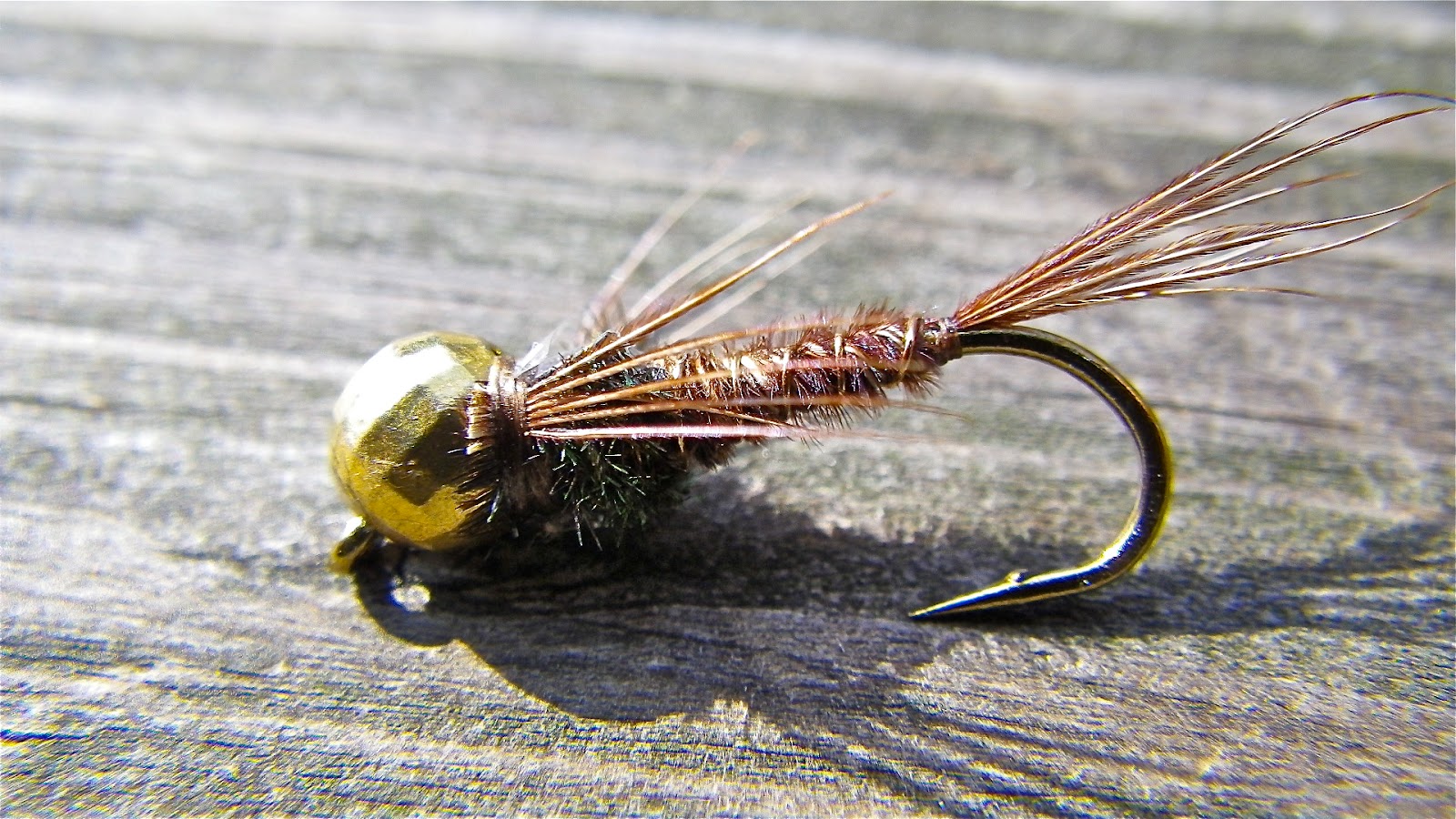
The Pheasant Tail Anchor


I thought I would share the details on this incredibly effective pattern.  I have mentioned it a few times on this site but have never really given a pattern recipe for it.  I am constantly amazed how well this disproportionate fly performs.  The tungsten bead on the head of this fly is three or four times the size it should be.

I tie it in two basic versions, one with a gold bead and one with a black bead and small orange hot spot.

Pheasant Tail Anchor - Gold Bead

Pheasant Tail Anchor - Black Bead

I should mention that I mainly fish this fly as part of a Polish or Czech nymph rig.  With my normal three fly set up, this pattern would be tied in the middle or anchor position.  It is the heaviest of the three flies and helps bring all of the patterns down to where the fish are.

A few quick notes on tying this pattern:
  1. A slotted bead is a must!  It is the only way you will get a bead this size on a #12 hook.  You must be careful on how you position this bead on the hook.  Slide it up and away from the hook point so you don't impede the hook gap and possible reduce the hooking ability of the fly.  A drop of super glue in the slot will hold in place if you need to.
  2. Tie the body as slim as possible, 6-8 fibers of pheasant tail is all you need.  I ensure I have a smooth under body which will often take a quite a few wraps of thread to close the gap between the hook shank and the lead under body in the thorax area.  Don't allow too much thread to build up, you want a slim tapered under body on which to wrap the pheasant tail.  I wrap the pheasant tail straight on without twisting with helps keeps that slim profile.
  3. Feel free to experiment with the legs.  The pattern fishes well as described here but may be even more effective with a few turns of rust brown CDC at the collar.  I tie the pattern both ways.  Feel free to omit the legs all together.  They are usually the first things chewed off the pattern after a few fish and the fly continues to work!
Pheasant Tail Anchor Recipe:
Hook:  Size 12 Dai-Riki 730  (2x long nymph hook)
Bead:  3/16 gold, faceted & slotted tungsten bead
Weight:  8 wraps of .020 lead wire (under the thorax area)
Wing case:  Peacock green mylar
Thorax:  Peacock herl
Legs:  8 pheasant tail fibers (4 off each side)
Ribbing:  Small gold wire
Abdomen:  Peacock tail fibers from the tail
Tail:  Peacock tail fibers (6-8)

Saturday, March 26, 2011

Last Day of the Winter Season


I was able to get out on Sunday, on the day trout season closed before the season opener on April 9th.  The weather was a bit more seasonable with the high just hitting 50 degrees.  The river was in great shape with normal spring time flows and good clarity.  It was all rainbows in the morning with browns becoming more active by mid day.

As usual for this time of year nymphing was the way to go, but the fish were more active, willing to move a bit more for the fly.  As on my previous trip the "spanker" was the bomb, with most of the fish taking this pattern.  This time I fished it on the top dropper so they were taking it higher in the water column. 


My pheasant tail anchor pattern with its giant over sized tungsten bead continues to rack up the numbers.  Why this fly is so effective is a bit of a mystery to me, as it produces well under all conditions.  I originally tied it to only act as weight to bring other flies into the zone, thinking the over sized bead would not be attractive to the fish. Either the fish don't notice the bead at all or they are actually attracted to it, the jury is still out on that one.


Another pattern that has been bringing up some nice browns has been a pink tungsten beaded San Juan Worm.  Rainbow trout don't seem to have any interest in this pattern but the biggest fish of the day (always brown trout) have been taking it. 


This chunky brown my buddy Rick caught is an example of the fish showing a preference for the "pinky".  This fly is tied a little differently than a traditional San Juan Worm.  In addition to the bead that is threaded onto the chenille before being mounted on the hook it has a thorax of shrimp pink vinyl d-rib.  I don't know if adds effectiveness to the pattern...it works so I'm not changing it.


The vast majority of the fish caught where rainbows and I did see some sporadic takes on top as fish were feeding on the abundant stone flies and midges that were flying about.  I think the reason the Lil' Spanker was working so well on the top dropper is that fish were taking it as a sunken adult stone fly.  Most of these stone flies were returning to the water to lay eggs so I imagine a number of them were ending up in the drink.


Nymph fishing was so effective I never bothered going on top.  In fact I ended up with two back to back doubles which has never happened before.  Four fish on two casts!


By the end of the day arms were tired, flies were chewed to shreds and there were loads of fish caught with a few real good ones in the mix.  I hope the season starts as good as it ended!

Thursday, March 24, 2011

Winter is Finally Over!

This was a long tough winter for me.  In a normal winter I will usually get a dozen or more trips under my belt before the season closes before opening day in early April.  This year it was looking like opening day would be my first time on the water.  As luck would have it last Friday my scheduled cleared at the last minute and I was on the water by noon.  The weather was unseasonable warm but the water was high, just coming down from flood stage earlier in the week.  Not perfect conditions, but with the season closing in two days there really wasn't another choice.


The day started a little slow but as the water warmed the fish turned on.  It was a Czech nymphing game as the high water had the fish pushed to the banks and in the softer water around the breaks, but the fish were there and they were eating.  The high roiled water allowed you to fish close most times not even getting your feet wet.


The fish were in great shape and looked like they passed through the winter in grand style.


Most of the fish were rainbows, but as the water warmed the browns started to wake up.


This is a new pattern this year and it produced very good.  I'll put up the pattern recipe in a few days.


The fish of the day was a big hen brown who ate the fly right on the bank in front of a log. 


With any luck there would be one more trip out before the season closed Sunday night...

Wednesday, March 23, 2011

Killing Time


I'm away on business and have a few hours to kill each afternoon. The portable tying kit is a pleasant distraction and is keeping from blowing my hard earned money in the casinos.


I have been reproducing a simple stone fly soft hackle pattern I found in the jaw of a 22" brown trout I caught over the weekend. Thanks to whoever was the original tier of this obviously effective pattern. A simple, impressionistic pattern that had obvious appeal to at least one big fish. I'll let you know if it works for me...

- Posted using BlogPress from my iPhone

Location:Boardwalk,Atlantic City,United States

Tuesday, March 22, 2011

Delektable Lil' Spanker


If I ever cross paths with Ben Romans I am gonna buy that man a beer!  I have been working my way through his book Montana's Best Fly Fishing.  In his section on the Madison River he mentions this fly.  I tied up a dozen and got them wet this weekend.  This pattern out fished everything else I fished two to one so it has earned a permanent spot in my box.  You can find a review on the book on the Chronicle Outdoors blog.

Here is the pattern as described in the book.

Hook:  #14-18 Tiemco 5262
Thread:  Brown 6/0 Danville
Bead: Gold
Tail:  Eight fibers of mallard dyed woodduck gold
Body:  Six fibers of brown pheasant tail, covered in super glue (I omitted the super glue)
Rib:  Counter wrapped gold wire
Thorax:  Peacock Ice Dub
Wing case/legs:  Light blue dun midge flash
Hackle:  Natural gray CDC
Collar:  Dark Hare's Ear Plus dubbing